Best Battery Mowers for Small Yards (Under ¼ Acre)
Small lawns are the easiest case for battery power, and the marketing makes it the hardest. Nobody sells you “a mower for 4,000 square feet” — they sell runtime minutes, torque numbers, and 21-inch decks designed for lawns twice yours. The result is that owners of small yards routinely buy twice the mower they need and then store it.
This page does the opposite. We’ll work out the actual energy a small lawn demands, show why one battery clears that bar with room to spare, and then spend the savings deliberately. (Looking for the general yard-size framework first? Start at the yard-size hub.)
How small is a “small yard”?
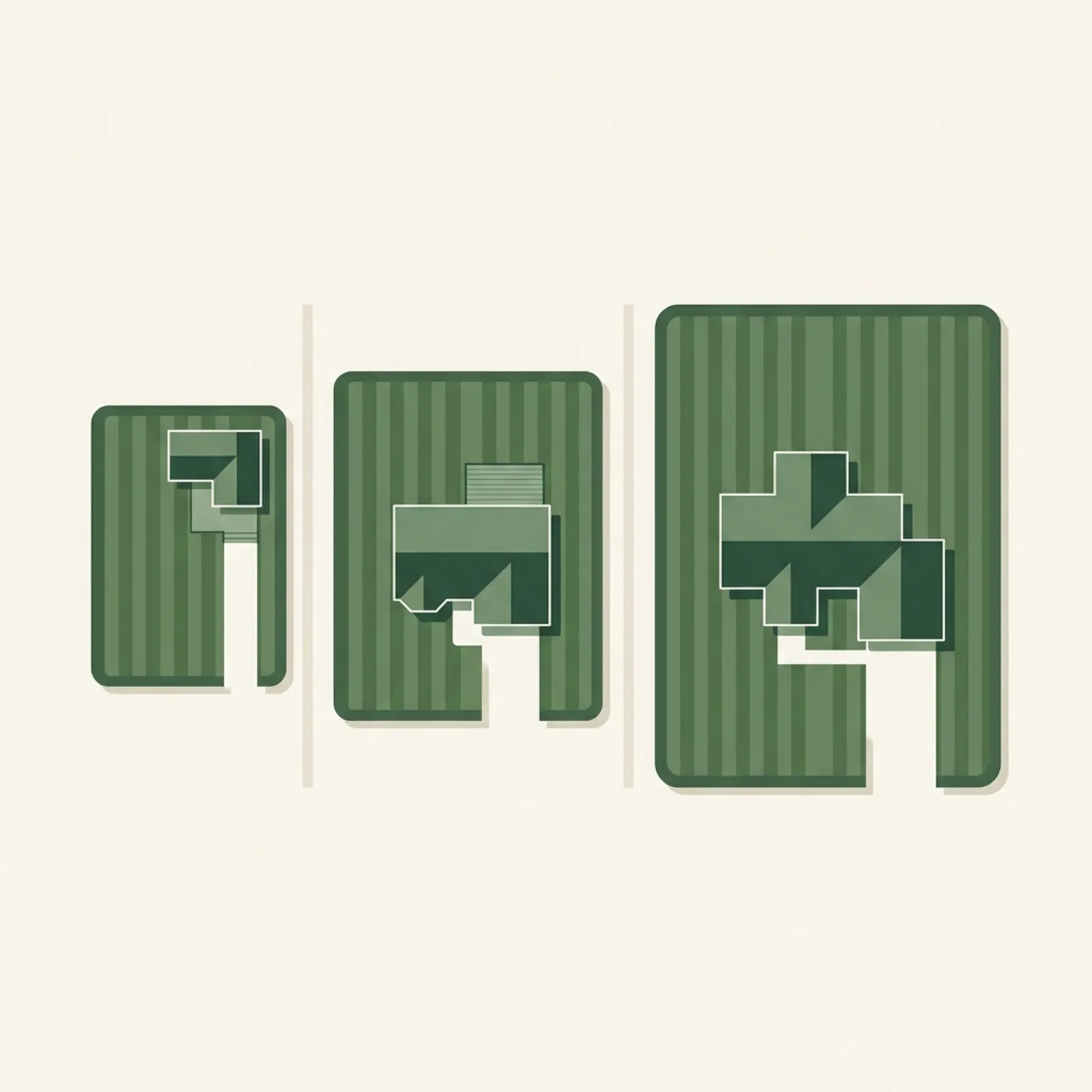
Throughout this site we use lot size as the shorthand and mowable turf as the real number, because your house, driveway, and beds don’t need mowing. A typical city or townhouse lot of an eighth of an acre is about 5,400 sq ft total; at roughly 70 percent turf that’s around 3,800 sq ft of actual grass — about a third more than a full tennis court. Even a full quarter-acre lot usually tops out near 7,500 sq ft of grass, and that upper end belongs to our quarter-acre guide.
So the working range for this page is about 2,000–6,000 sq ft of lawn. If you’re in that band, every conclusion below applies to you. Not sure what you actually have? The yard size calculator converts your lot dimensions into mowable turf in about thirty seconds.
The watt-hour math: one battery is enough
Battery capacity marketing is a mess of volts and amp-hours. The number that predicts whether you’ll finish your lawn is watt-hours — volts × amp-hours — because it’s the total energy in the pack. If you’re new to this framing, our volts vs amp-hours explainer covers it in depth; here’s the short version with the packs in these mowers:
24 V × 4.0 Ah = 96 Wh. Watt-hours (volts × amp-hours) are the total energy in the pack — the number that actually predicts runtime. Why voltage alone doesn't tell the story.
40 V × 4.0 Ah = 160 Wh. Watt-hours (volts × amp-hours) are the total energy in the pack — the number that actually predicts runtime. Why voltage alone doesn't tell the story.
Now the demand side. As a planning estimate — label it as ours, not a lab number — a real lawn mowed weekly with a push mower consumes roughly 25–35 Wh per 1,000 sq ft, depending on grass thickness, how often you cut, and whether you bag. Multiply that by a small yard:
| Lawn size | Energy per cut (est.) | One 96 Wh pack? | One 160 Wh pack? |
|---|---|---|---|
| 2,500 sq ft (patio-home yard) | ~65–90 Wh | Yes, easily | Yes, easily |
| 3,800 sq ft (⅛-acre lot, ~70% turf) | ~95–135 Wh | Yes, with margin | Yes, easily |
| 5,000 sq ft (large small-yard) | ~125–175 Wh | Usually — tight in thick grass | Yes, easily |
| 6,000 sq ft (top of the class) | ~150–210 Wh | Marginal | Yes in most conditions |
Two honest footnotes. First, thick, wet, or overgrown grass pushes consumption toward the high end and past it — nobody’s estimate survives a jungle. Second, manufacturer runtime ratings (“up to 35 minutes”) quietly assume the easy end; the Wh framework above is deliberately more conservative.
The conclusion is still clean: one ordinary battery finishes a small yard with charge to spare. You do not need a second pack for runtime. A second small pack is only worth owning as a convenience for the trimmer, not as a mower necessity. That single fact should steer your whole budget.
Check availability on AmazonWhat a small yard actually demands
Since power is off the table as a differentiator, small-yard mowers should be judged on the things you’ll notice every week:
Weight and handling. You will lift this mower over a curb, drag it through a gate, and spin it around planting beds dozens of times per cut. Around 30 lb feels very different from 60-plus, and it matters more than any torque figure. (Our full lightweight mowers guide goes deeper here.)
Storage footprint. Small yards usually mean small garages or sheds. A 13-inch deck can store upright or on a shelf; a 21-inch steel deck cannot. This is the most underrated spec on the page.
Battery platform, not battery count. The pack that mows your lawn can also run a string trimmer, a blower, or a hedge trimmer if you stay in one brand’s voltage family. On a small yard, the mower is really the entry drug to a cordless yard system — so pick the family you want to live in. The batteries hub maps out the major ecosystems.
Noise. Battery mowers are quiet across the board, but small decks with small motors are quieter still, and your neighbors are close. This is a genuine small-yard advantage — early-morning cuts stop being a diplomacy problem.
The three best battery mowers for small yards
Three mowers cover the small-yard market honestly: a minimal pick that treats the mower as an appliance, a mid pick that buys back walking time, and an ecosystem pick if you already own — or intend to own — bigger cordless tools.
Best value for small yardsThe MO24B410 is the mower that matches the math above. It exists precisely because 96 Wh is enough for this class: no second pack to buy, no fast charger to upgrade, no self-propel motor to feed. The 4.0Ah battery has a USB port, which is a small thing that owners genuinely use, and it crosses over to every other tool in Greenworks’ 24V line — one of the biggest budget tool families around (see the Greenworks ecosystem).
Its limits are the flip side of its virtues. The 13-inch deck means more passes than a wider mower, the maximum cut height tops out at 2.75 inches — lower than some warm-season lawns want in peak spring — and there’s no self-propel, none of which matters much at 3,800 sq ft and all of which would at three times that size.
Pros
- One included battery covers the whole job
- Around 30 lb — easy to carry and store
- 24V battery runs the wider Greenworks 24V tool family
- Polymer deck will never rust
- Typically the least expensive way into a real mower
Watch-outs
- 13-inch deck means the most passes of any pick
- No self-propel (fine here, wrong for bigger lawns)
- Small wheels struggle with rough lawn edges
- Recharging takes about two hours
The WG743 is the pick when your yard is at the top of the small range or your grass runs thick. WORX rates it for up to about an eighth of an acre per charge, and owners commonly report 30–45 minutes of mowing — which at this yard size means you finish, every time, without thinking about the battery. The 17-inch deck is the sweet spot for small lawns: wide enough to reduce pass count meaningfully, narrow enough to keep the mower light and store flat against a wall.
The platform logic is strong too: the two 20V Power Share batteries run the entire WORX 20V tool line, so the mower effectively comes with two tool batteries included. The trade-offs are a polymer deck at this width (durable but flexier than steel) and a push-only drive — normal for the class.
Why include a 21-inch self-propelled flagship on a small-yard page at all? Because the right answer changes if you already own EGO gear. If a 56V battery and charger are sitting in your garage from a snow blower or trimmer, the LM2110SP becomes just a deck purchase, and its advantages — steel deck, self-propel for the sloped corner, EGO’s five-year tool warranty — start costing a lot less real money. EGO lists up to 50 minutes of runtime with the recommended 6.0Ah pack; your lawn will use a third of it.
If you’re starting from zero, though, this is more mower than a small yard needs, and the money is better spent below.
View this mower on Amazon13 vs 17 vs 21 inches: the pass math on a small lawn
Deck width changes how far you walk, and walking distance is the actual experience of mowing a small lawn. Using the standard method — effective stripe is deck width minus an inch of overlap — here is a 3,800 sq ft yard (roughly 40 × 95 ft) at each deck size:
| Deck | Effective stripe | Passes across a 40-ft yard | Total walking (est.) |
|---|---|---|---|
| 13″ | 12″ | ~40 | ~0.7 mile |
| 17″ | 16″ | ~30 | ~0.55 mile |
| 21″ | 20″ | ~24 | ~0.45 mile |
Read that as minutes: on a small lawn the difference between the 13-inch and 17-inch decks is about five minutes of walking per cut, and about ten minutes to the 21-inch. Real, but not life-changing — which is why we’d let storage space and battery platform decide before pass count at this yard size. The deck size guide and the deck-passes calculator let you run your own lawn’s numbers.
What to spend the savings on
The Greenworks pick typically costs a couple of price bands less than a flagship 21-inch kit. Here’s the neighborly order of operations for that difference:
- A matched string trimmer first. The edges are half the visual job on a small yard, and a trimmer running the same battery as your mower is the whole point of staying in one platform. This is where small-yard buyers get the best value-per-dollar in outdoor power.
- A leaf blower second. Same battery, same logic, and on a small lot one pack cycles between three tools all Saturday morning.
- A fast charger before a second battery. If your one pack ever runs short, a faster charge fixes it for less than a new pack — check the charge time on whatever kit you buy, because the included charger is often the slow one.
- Not self-propel. On flat, small lawns it’s dead weight and battery drain. Our self-propelled vs push guide estimates the runtime tax at 20–30 percent — a real cost for a benefit you’ll rarely feel at this size.
Yard Fit Rating
- Yard class
- Small urban or townhouse yard
- Comfortable up to
- 0.25 acre
- Recommended deck
- 13–17 in
- Batteries for the job
- 1 × 4.0Ah class (96–160 Wh) — a second pack is convenience, not necessity
Who each pick is for
Buy this if…
Your lot is under ¼ acre, you want the cheapest complete solution that still mows well, and you’d rather spend the difference on a trimmer and blower in the same battery family — get the Greenworks MO24B410.
Skip this if…
Your lawn is a thick, fast-growing variety like St. Augustine or you’re regularly cutting 5,000+ sq ft — the 13-inch deck and single 96 Wh pack start feeling slow and tight. Step up to the WORX or read the quarter-acre guide.
Consider instead if…
You already own EGO 56V batteries and charger — the LM2110SP becomes a cheap deck upgrade and beats rebuying into a new platform.
Small-yard battery mower FAQ
Is a battery mower really enough for a small yard?
Yes — small yards are the one case where a cordless mower is simply the best tool, not a tradeoff. Your entire lawn needs roughly 100–150 Wh per cut, a single included pack carries 96–160 Wh, and you skip gas, oil, winterizing, and engine maintenance entirely.
Do I need self-propel on a small lawn?
Almost never. Self-propel earns its keep somewhere past a quarter acre, on slopes, or in thick wet grass; on a flat small lawn it adds weight, cost, and a 20–30 percent battery drain (our estimate) to save you a few minutes of easy pushing.
Should the trimmer use the same battery as the mower?
Yes, if you can. That’s the strongest argument for buying your mower inside a real platform: the Greenworks 24V line, WORX’s 20V Power Share system, and EGO’s 56V line all run trimmers, blowers, and hedge tools off the same packs. One battery family, several tools, no duplicate chargers.
How long will the battery last before it needs replacing?
Lithium packs in this class typically deliver on the order of 300–500 charge cycles before capacity noticeably fades — for a small yard mowed weekly, that’s many seasons. Warranties on the pack run shorter than the tool with most brands, so check the terms for whichever mower you buy.