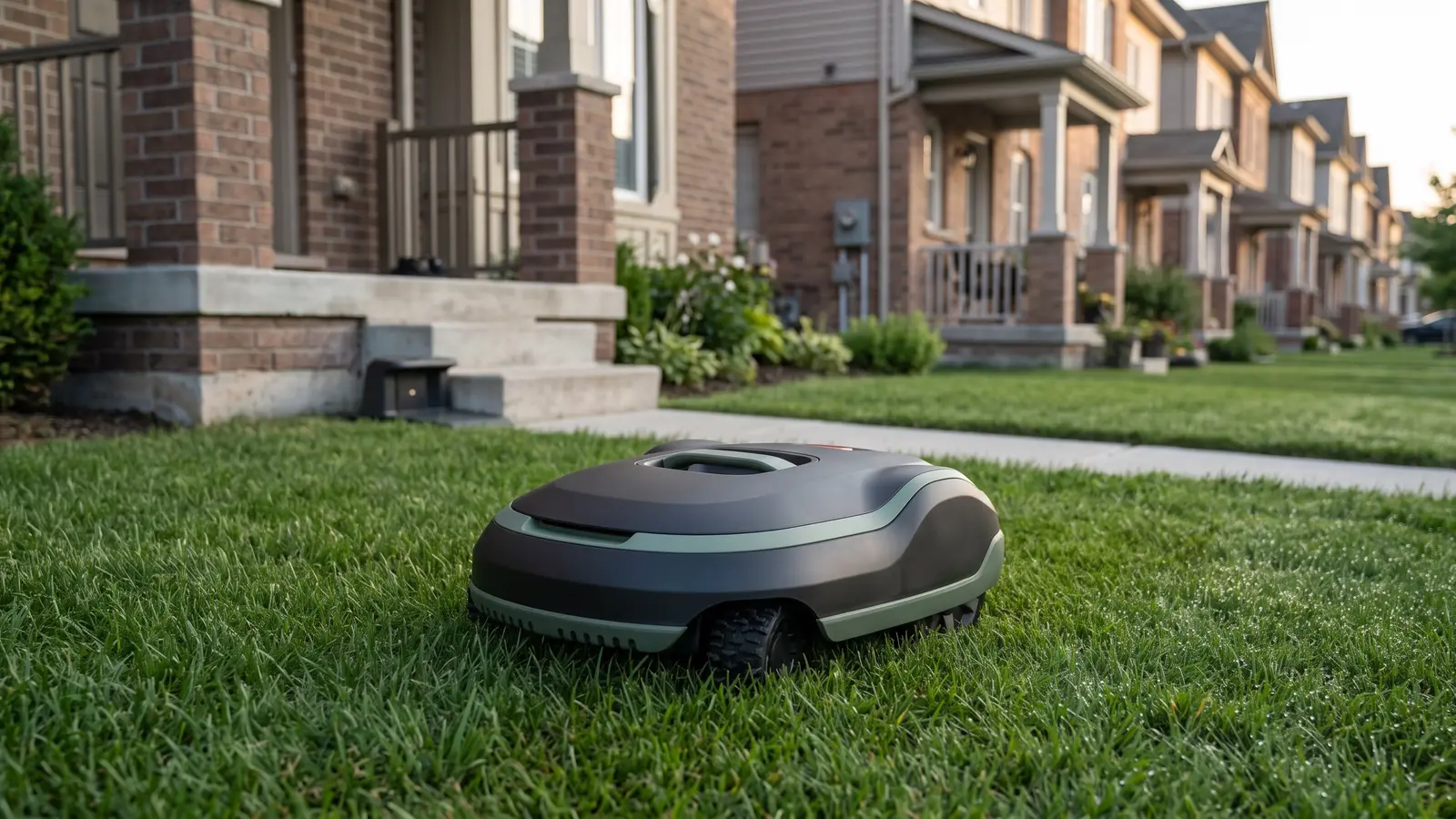
Segway Navimow i105N Review: The ⅛-Acre Wire-Free Entry Point
The i105N is the machine that turned wire-free robot mowing from a $2,000-plus flagship purchase into a normal-lawn purchase. It is Segway Navimow’s compact model: rated for lawns up to ⅛ acre, navigating by satellite correction plus an onboard camera, mapping the lawn from a phone, and running quiet enough for neighbors who can hear your entire life through the fence. For the right yard it is the least expensive way to never push a mower again — and for the wrong yard, it is an education in why the navigation spec matters more than the price tag.
What you’re buying
| Spec | i105N (current US listing) |
|---|---|
| Rated coverage | Up to ⅛ acre (0.125 acre) |
| Navigation | RTK + Vision (EFLS 2.0) |
| Drive | Two-wheel drive |
| Operating volume | 58 dB(A) listed |
| Zones | Multi-zone management |
| Connectivity | App control; optional 4G module |
| Boundary | None — virtual, app-mapped |
The pattern to notice: nothing here is a stretch number. Coverage is quoted as a rating, the volume figure is listed, and the two-wheel-drive layout is stated plainly rather than dressed up. That honesty matters in a category where listings like to quote maximum coverage and hope you read it as the rating — the yard-size guide on this site explains why you always buy against the rated figure.
How it navigates: RTK plus a camera
The i105N’s positioning stack is the reason it can sell at an entry price and still mow in straight, systematic lines instead of wandering like the old boundary-wire robots. The navigation explainer covers the full physics; the short version:
- RTK (satellite correction) gives the mower centimeter-class positioning outdoors — this is the same principle surveying equipment uses, miniaturized and paired with a small antenna you place with a clear view of the sky.
- The vision camera backs the satellite lock up: it recognizes the difference between grass and not-grass, spots obstacles, and keeps the mower honest where satellite correction softens near trees or walls.
You map the lawn once by walking the boundary in the app; from then on the mower works inside that virtual fence, in systematic passes, recharging at its dock on its own. Navimow’s own intro film shows the workflow end to end:
What owners actually get from it
The site’s owner-experiences coverage reads across fourteen owner threads, and the pattern for compact robots like the i105N is consistent: the win isn’t novelty, it’s the calendar. A lawn that gets mowed three or four times a week at a quiet 58 dB(A) — early morning, while you’re doing something else — stops being a chore and starts being a condition of the property. The edges remain the honest trade: robots of this size leave a trimmer-width rim at obstacles and beds, which you either accept as the price of never mowing, or handle with a weekly string-trimmer pass.
Setup is the other consistently reported win for this generation: place the dock, place the antenna with sky view, walk the boundary in the app. No trenching, no wire splices, no broken-wire archaeology — the failure mode that defined two decades of boundary-wire robots.
The honest limits
- Canopy. RTK correction needs sky. A lawn that’s mostly open is the i105N’s home turf; a lawn shaded by mature trees across most of its area will test the vision backup harder than it was designed to be tested. If shade defines your yard, a LiDAR-first machine is the correct purchase — the navigation explainer explains why.
- Slope. Two-wheel drive, and the listing doesn’t advertise a slope rating — which this site treats as a reason to size up, not a green light. Gentle grades are fine; anything you’d describe as a hill belongs to the i210 AWD class or the AWD flagships.
- The ceiling is real. Rated ⅛ acre means exactly that. Owners who “plan to expand later” are the classic mismatch — buy the coverage you’ll have in two years, not the coverage you have now.
- Single mower, single lawn size class. This is a purpose-built small-lawn machine; it is not a smaller version of a flagship. Expecting flagship multi-zone choreography (30 zones, drop-and-mow, hot-swap batteries) at this price is a category error.
The step-up decision
The i105N’s most common cross-shop is its own sibling. The Navimow i210 AWD adds all-wheel drive, a 45% slope rating, 0.25-acre coverage, and 20-zone management — the right call if any of those four words describe your lawn. The best-by-yard-size guide places both in context, and the Navimow vs Mammotion comparison shows how the whole Navimow philosophy stacks against the LiDAR-first camp.
The other honest alternative isn’t a robot at all: for a small flat lawn, a cordless walk-behind is a $300–500 problem, and the robot vs walk-behind cost math is worth running before you spend robot money. The i105N wins that math when your answer to “would you pay to never mow again” is yes — not when it’s maybe.
Winter and maintenance
Like every robot on this site, the i105N winters indoors: end the season charged, storage mode on, robot and dock dry, and the map checked at spring wake-up. The routine is in the winter storage checklist. Blade checks follow the same cadence discipline as a walk-behind — pivoting razor blades are consumables, and the sharpening guide’s replace-vs-maintain logic applies, with robot blades being replace-only.
Add to cart on AmazonFAQ
Black Friday & Cyber Monday: judging the deal
Is the Navimow i105N good for a small lawn?
Yes — that is precisely its design brief: rated up to ⅛ acre of mowable turf, quiet (listed 58 dB(A)), compact, and virtual-boundary mapped. For townhouse and small suburban front lawns that are mostly open to the sky, it’s the entry point that made the category mainstream.
Does the i105N need boundary wire or an antenna?
No boundary wire — boundaries are virtual, drawn in the app after walking the perimeter. RTK models do use a small reference antenna placed somewhere with a clear view of the sky; that’s a one-time placement, not an installation project.
Can the i105N handle a sloped yard?
Not meaningfully — it’s the two-wheel-drive model and the listing advertises no slope rating. Gentle, even grades are fine; for real slopes the i210 AWD (45% rating) or the AWD flagships in the yard-size guide are the correct machines.
Will it work under big trees?
Partially. RTK correction degrades under dense canopy, and the i105N’s backup is vision, not LiDAR. Scattered trees are fine; a mostly-shaded lawn should buy LiDAR-first navigation instead — the navigation explainer covers the trade in depth.
How loud is it really?
The listing says 58 dB(A) — the class Navimow compares to a normal conversation, quiet enough for early-morning runs near bedrooms. It mows several times a week, so the quiet spec matters more than it would for a once-a-week machine.