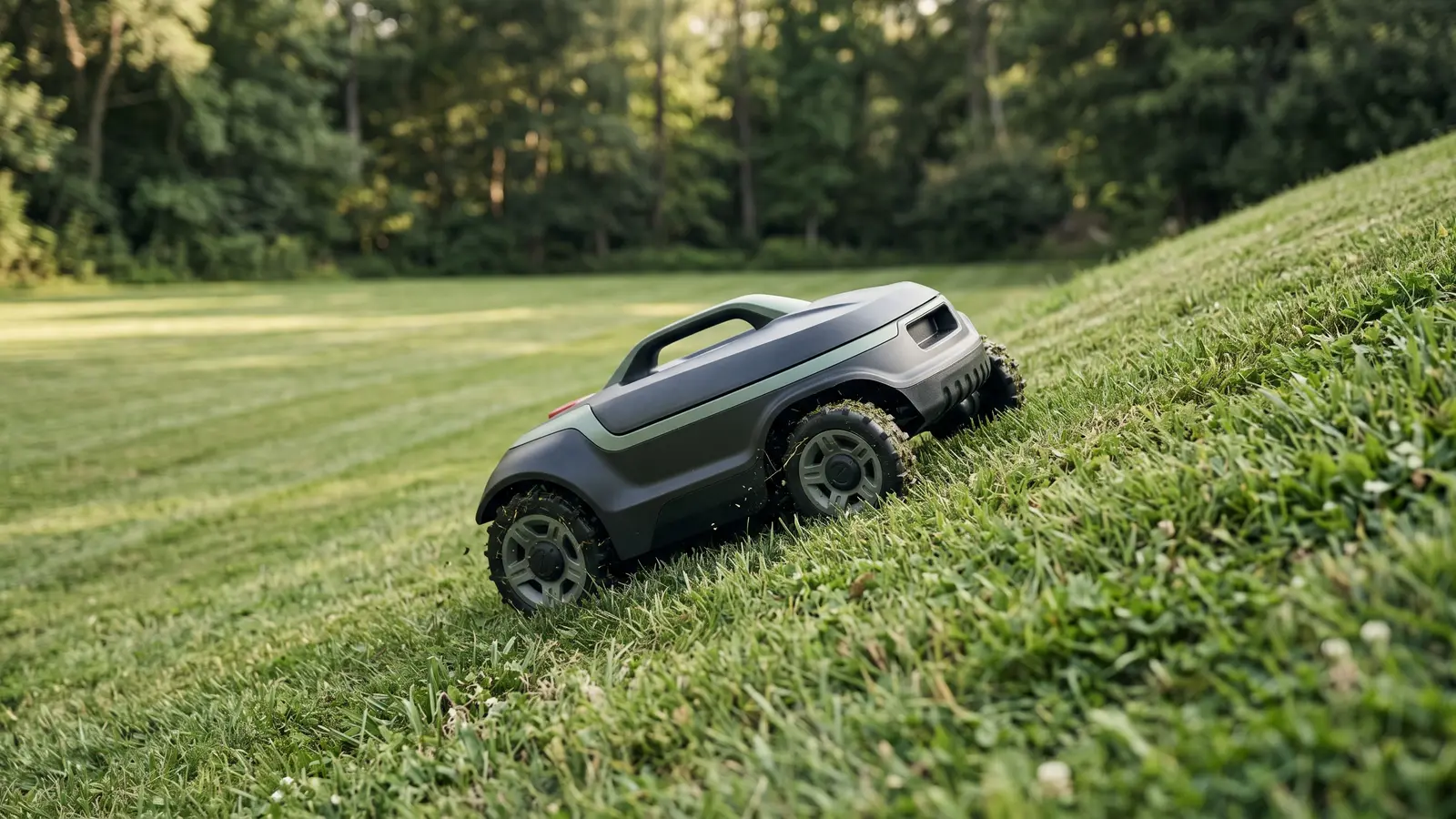
Mammotion LUBA 3 AWD Review: Tri-Fusion Navigation for Hard Yards
The LUBA 3 AWD is Mammotion’s answer to the hardest problem in robot mowing: the yard that has everything. Slopes that would stop a two-wheel-drive robot, tree cover that starves satellite positioning, zones chopped up by a house and fences — the LUBA 3’s pitch is that it stops choosing between those conditions because it navigates all three ways at once. Mammotion calls it Tri-Fusion: 360° LiDAR, network RTK, and AI vision on one chassis, with all-wheel drive underneath.
What you’re buying
| Spec | LUBA 3 AWD 3000H (current US listing) |
|---|---|
| Rated coverage | 0.75 acre |
| Navigation | 360° LiDAR + NetRTK + AI vision (Tri-Fusion) |
| Drive | All-wheel drive |
| Slope rating | 80% |
| Zones | 30-zone management |
| Cutting height | 2.2–4.0 inches |
| Connectivity | App control, 4G service included for a period |
Two numbers do most of the work here. 80% slope is the AWD rating Mammotion has built its reputation on — steep enough that the constraint becomes your ankles, not the robot. And 30 zones is a genuine multi-lawn number: front, back, side, plus the strip past the driveway, each scheduled independently.
The third quiet spec is the cutting-height range. At 2.2–4.0 inches, the ceiling sits above most compact robots, which matters if you run warm-season grasses or simply prefer a taller, drought-hardier lawn — the grass-type guide covers why that ceiling earns its keep.
Tri-Fusion, in plain language
The site’s navigation explainer covers each system in depth; what matters on this page is the fusion logic:
- LiDAR (a 360° laser sweep) builds a geometric map of the yard that doesn’t care about satellites or light. It is the layer that keeps the LUBA 3 working under the big maple where RTK-only robots drift.
- NetRTK delivers centimeter-class satellite correction over the network — no base station antenna to site, though Mammotion’s platform supports reference hardware where coverage is weak.
- AI vision handles the last meter: obstacle classification, edge behavior, the difference between a hose and a hedgehog.
The practical translation: the LUBA 3 degrades gracefully. Where one system weakens — canopy kills RTK, darkness limits vision, featureless fences confuse nothing but prove little — the other two carry it. Single-system robots either don’t enter those zones or guess.
Mammotion’s launch film shows the machine working terrain that would strand most robots:
Where it beats the field, and where it doesn’t
| Model | Rated area | Slope | Navigation | Best when |
|---|---|---|---|---|
| Mammotion LUBA 3 AWD 3000H | 0.75 acre | 80% | LiDAR + NetRTK + vision | Canopy + slopes + zones together |
| Mammotion LUBA 2 AWD 3000HX | 0.75 acre | 80% | RTK + UltraSense vision | Slopes and acreage, open sky |
| Segway Navimow X430 | 1 acre | 84% | RTK + Vision | Biggest open lawns, steepest rating |
| Dreame A3 AWD Pro | up to 1.2 acre | 80% | 360° LiDAR + dual vision | Tree-heavy acreage, anti-theft priority |
Read the table as a difficulty-matching exercise, not a ranking. The LUBA 3 wins when your yard stacks all three difficulty axes; on any single axis a cheaper machine can tie it. The X430’s 84% edge matters only if your worst bank is genuinely past 80%; the Dreame’s LiDAR-first stack covers canopy too (see the Dreame A3 review); the LUBA 2 does the open-sky version for less. The Navimow vs Mammotion comparison lays out the two ecosystems’ philosophies line by line.
The honest limits
- It’s a big machine for a category that rewards right-sizing. On a simple open lawn, you’re carrying LiDAR hardware you’ll never lean on. The rated-area ladder exists precisely so you don’t overbuy.
- Rated 0.75 acre, not 1.5. Buy against the rating, never the marketing maximum — the same discipline as every page on this site.
- Complexity is real. Thirty zones, vision sensitivity settings, and three navigation systems mean the app matters. Mammotion’s app has matured well by owner accounts, but plan an afternoon for first setup, not ten minutes.
- Edges are still edges. Like every robot in this class it leaves a trimmer rim at true obstacles; the honest question is whether your boundary is grass-to-bed (fine) or grass-to-fence-corner (weekly trimmer pass).
Ownership notes
The LUBA 3 winters like every robot here: season-end charge, storage mode, dock and machine indoors, map check at wake-up — the full routine is in the winter storage checklist. Its cutting discs take replaceable pivoting blades; consumption scales with acreage, so a spare set in the drawer is cheap insurance against a mid-season dulled edge (the symptoms are the same streaking a walk-behind shows).
Check availability on AmazonFAQ
Black Friday & Cyber Monday: judging the deal
What lawn size is the LUBA 3 AWD 3000H rated for?
0.75 acre of mowable turf per the current US listing — with the standing rule on this site to buy against the rated figure, not any maximum the marketing mentions. For genuinely larger properties, the yard-size guide’s ¾-acre-plus section lists the 1-acre-plus machines.
What does Tri-Fusion navigation actually do?
It runs 360° LiDAR, network RTK, and AI vision simultaneously, so the robot keeps precise positioning where any single system weakens — under tree cover (LiDAR carries), in open sky (RTK carries), and around obstacles in the last meter (vision carries). Single-system robots have to avoid their weak zones; fused platforms mow through them.
Can it really climb an 80% slope?
The 80% (roughly 39°) rating applies to the AWD system in listed conditions — it’s the figure Mammotion built its reputation on and among the highest in the category. Wet grass, ruts, and transitions at the slope edge remain real-world factors; size the rating with margin rather than at the limit.
LUBA 3 or LUBA 2 AWD?
Same 0.75-acre rating and 80% AWD pedigree. The LUBA 3 adds the 360° LiDAR layer and 30-zone management — buy it when canopy or zone complexity is real. On open, sloped ground the LUBA 2 AWD 3000HX covers the same job with an RTK-plus-vision stack, typically for less money.
Does it need a base-station antenna in the yard?
Network RTK is the default — corrections arrive over the network, with no antenna to site. Mammotion supports reference hardware for weak-coverage properties, which is worth checking against your location before buying if you’re far from anywhere.