How to Store a Cordless Lawn Mower for Winter (Complete Checklist)
A cordless mower survives winter on two decisions: where the machine sleeps, and where the battery does. The mower itself is nearly indestructible in storage — a brushless motor has no carburetor, no gas, and no oil to degrade. The battery is the opposite: a lithium pack left empty in a freezing shed all winter is the single most common reason a mower won’t start in spring. Storage that protects the pack is storage that works.
Why winter storage is mostly battery storage
The site’s battery lifespan coverage puts the pattern plainly: lithium packs are rated for roughly 300–500 charge cycles, and what kills them early is rarely the mowing — it’s the storage between seasons. A pack that sits fully drained for months in cold temperatures can fall below the voltage its protection circuit will allow a charger to recover. The mower reads that as “no battery installed.”
The machine side is simpler. Cordless decks hold up fine in a shed or garage over winter if they’re clean and dry. Rust on a deck is cosmetic; a deeply discharged pack is a replacement — and replacement packs run $100+ each.
That asymmetry sets the priorities: spend five minutes on the mower, fifteen on the batteries.
The mower checklist (about ten minutes)
- Cut the grass one last time before storing. Storing a mower after a final, normal-height cut means you start spring with a manageable lawn instead of a jungle that overloads the motor and drains the pack — the thick-grass guidance applies double to the first spring mow.
- Clean the deck underside. Scraped-on grass clippings hold moisture against the deck all winter. With the battery removed, tip the mower per the manual’s direction and scrape the deck clean. A plastic scraper does the job; a hose is unnecessary and invites rust in nooks that never dry.
- Inspect the blade while you’re under there. Nicks, a rolled edge, or a bent blade are worth noting now so you can sharpen or replace over the winter instead of discovering it mid-April. The sharpening cadence guide covers when each condition is a sharpen versus a replacement.
- Check wheels, handle hardware, and the grass bag. Tighten what’s loose, empty the bag, and let it dry fully before storage. A damp bag sealed in a shed all winter comes out smelling like a compost experiment.
- Wipe the battery contacts on the mower and on each pack. Oxidation on contacts is a known no-start cause in spring — the troubleshooting guide walks the full ladder if it happens.
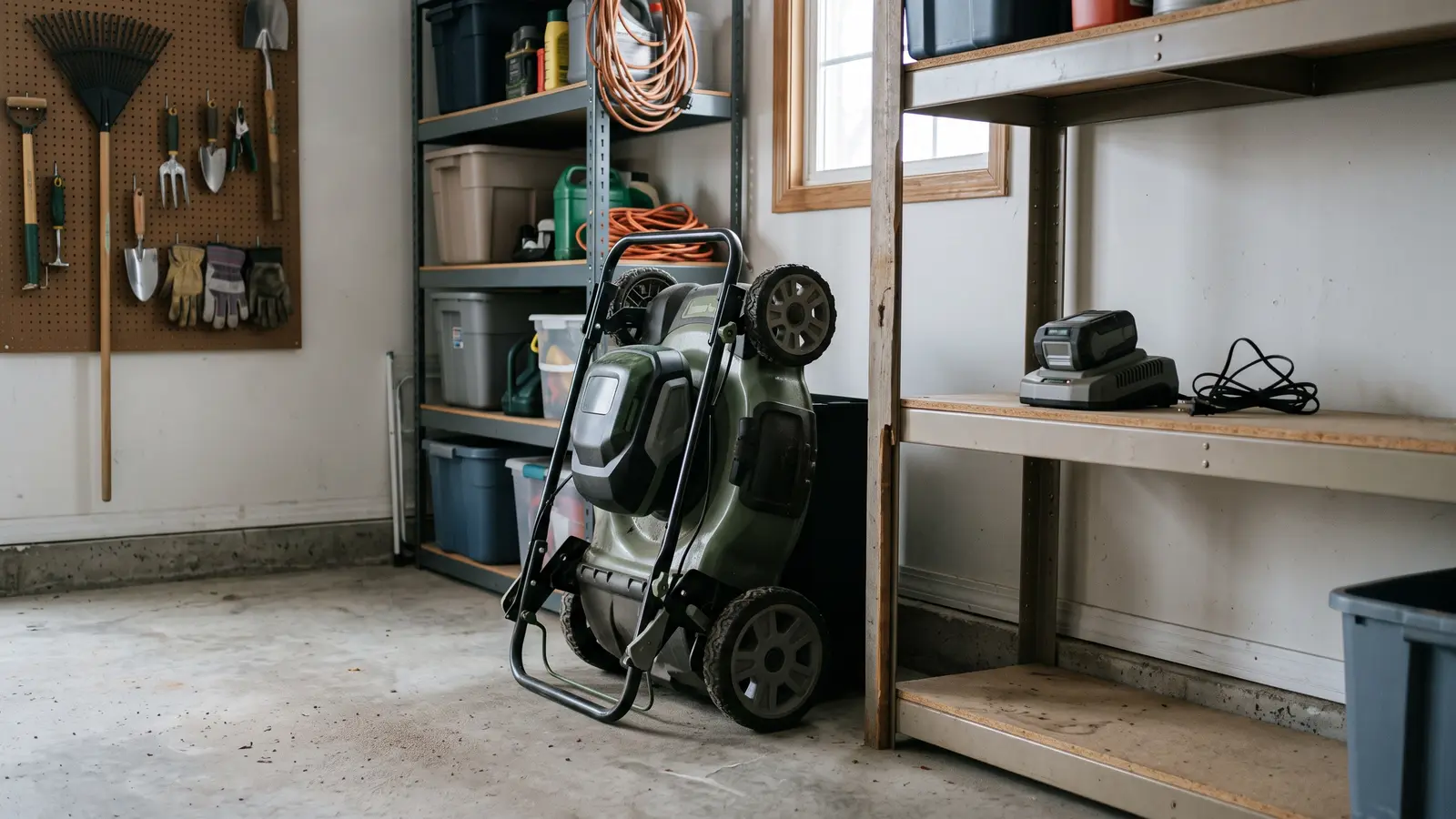
Then park the machine: folded upright if the model allows it (most modern cordless mowers do), in a dry shed or garage, out of direct weather. A cover helps if the storage space is dusty.
The battery rules (the fifteen minutes that matter)
Why half charge. A lithium pack stored at empty can self-discharge below its protective floor over a long winter; a pack pinned at 100% and left on the charger ages faster. Around half charge is the sweet spot manufacturers’ care guidance converges on: enough reserve above the floor, low enough stress on the cells.
Why indoors. “Indoors” means a climate-controlled room — a shelf in the house, a utility room, an interior closet. An unheated garage or shed swings through freezing and thawing; lithium chemistry dislikes both extremes, and a pack that drifts too low while cold is the classic spring no-start. The pack rides inside even when the mower stays in the shed.
Why off the charger. A charger is a charging tool, not a maintainer. Leaving a pack on it all winter holds the cells at maximum voltage, which is exactly the storage condition that shaves cycle life. Charge to half, unplug, shelf.
The winter check-ins. Every eight weeks or so, press each pack’s charge indicator. If a pack has drifted toward empty, put it on the charger just long enough to return to the middle of its range. Ten minutes of attention in January is why the mower starts in March.
For how many packs you should own and how to rotate them, the two-battery strategy in the runtime guide and the mixing-sizes guide cover the math — a spare pack stored well both hedges winter and doubles summer mowing capacity.
Robot mowers in winter: shorter checklist, same battery logic
Wire-free robot mowers are battery machines with a roof — winterize the power system and the rest mostly follows:
- End the season at a scheduled full charge, then power the robot down per its manual (most current models have an explicit storage or hibernation mode rather than a hard switch).
- Bring the station and antenna inside if the manufacturer’s winter guidance says so — RTK antenna hardware is generally fine outdoors, but the dock’s power supply is happier dry.
- Store the robot itself indoors, dry and cool, just like a walk-behind pack: the battery is inside it, so the same half-charge-before-long-storage logic applies through the robot’s own storage mode.
- Spring wake-up is a firmware-and-map check, not just a charge: confirm the app still shows the map and boundaries before the first autonomous run. The robot mower hub covers what normal operation looks like; the same first-start caution applies to a robot that sat through a hard freeze.
The spring wake-up routine
When the frost risk passes, reverse the checklist in this order:
- Fully charge every pack — first charge of the season, indoors, while you do everything else.
- Re-read the blade notes from fall. If you deferred a sharpen or replacement, do it now; the first cut of spring is the hardest the blade will do all year.
- First mow: normal height, slow pace. Don’t scalp the spring growth — the first-cut discipline in the thick-grass guide is the right pattern for any lawn that grew unchecked.
- If nothing happens when you pull the bail: stop guessing and run the ordered ladder in the won’t-start-after-winter guide — battery, charger, contacts, interlocks, in that order. Nine times out of ten the fix appears in the first two steps.
Plan next season while it’s fresh
Winter is also when next year’s mowing math is cheapest to do. Two of the site’s calculators exist exactly for this:
- The battery runtime calculator turns your lawn’s square footage and your pack’s watt-hours into a realistic pass budget — useful for deciding whether a second pack belongs on the spring list before the season starts.
- The deck passes calculator compares how many passes your deck width needs, which is the number that decides whether a wider deck or a bigger pack is the better upgrade.
And if winter reflection is pointing toward a machine that mows while you’re at work, the robot mower comparison does the honest cost-per-year math between keeping the walk-behind and upgrading.
FAQ
Can I leave the battery in the mower over winter?
Physically you can, but it’s the wrong shelf. The pack should winter indoors, in a cool dry room, at about half charge — the mower can stay in the shed, the pack cannot. A pack left installed in a freezing shed drifts down over months, and a deeply drained pack is the most common reason a mower won’t start in spring.
Should mower batteries be stored fully charged?
No. A pack pinned at 100% — especially left on its charger all winter — ages faster than one stored around half charge. Charge to roughly the middle of the range, take it off the charger, and check every couple of months through the season.
How cold is too cold to store a battery mower?
The machine tolerates a freezing shed fine. The battery does not: manufacturers’ care guidance calls for cool, dry, indoor storage — a climate-controlled room, not an unheated garage that cycles through hard freezes. If the space freezes, the pack comes inside.
Do I need to do anything to a robot mower for winter?
End the season with a full charge, activate its storage or hibernation mode, bring the robot and (per the manual) usually the dock indoors, and confirm the map still shows in the app at spring wake-up. The battery logic is identical to a walk-behind pack — the robot just carries its own.
What's the single most common spring no-start cause?
A battery that spent winter discharged in the cold. It presents as a dead mower but is usually a pack below its recoverable voltage. Test with a second pack before concluding anything about the mower itself — the troubleshooting guide puts that step first for a reason.