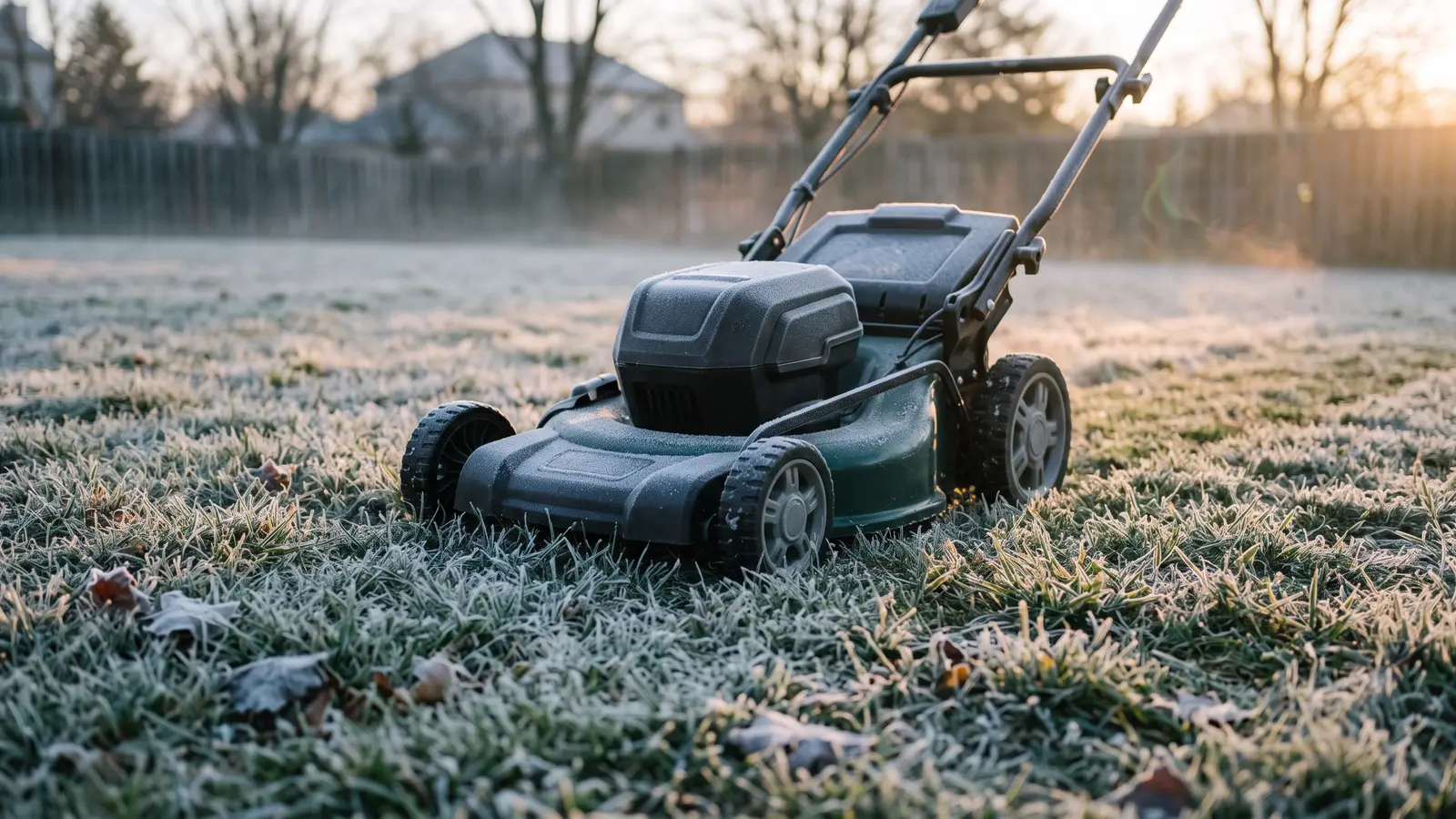
Battery Mower Won't Start After Winter? Troubleshoot in This Order
When a battery mower sits down after winter and refuses to start, the motor is the least likely suspect. A brushless motor has no carburetor to gum up and no pull cord to snap — the failure almost never lives there. It lives in the chain that feeds the motor: the battery pack, the charger, the contacts between them, and the safety interlocks that decide whether the mower is allowed to run at all. Work that chain in order and most spring no-starts are solved in the first two steps.
Step 0: the thirty-second test that solves most cases
If you own a second pack for the platform — and the runtime guide’s case for owning one starts exactly here — charge it and install it. Mower starts: the original pack is the problem, skip to step 3. Mower still dead: continue down the ladder, and the good news is you’ve just cleared the most expensive suspicion.
No second pack? Everything below still applies; you’re just doing the diagnosis with one pack instead of two.
Step 1: the battery pack itself
The winter-storage guide covers why a pack left cold and empty all winter can end up below the voltage its own protection circuit will let a charger recover. What that looks like from the outside:
- Press the pack’s charge indicator. No lights at all, on a pack that charged fine last fall, is the deep-discharge signature.
- Put it on its charger indoors at room temperature and watch the indicator. Some packs that refused a charge cold will begin accepting one after an hour at room temp — cold cells charge reluctantly, and lithium chargers refuse what they can’t safely feed.
- Give it a genuine full charge, not a green-light glance. A pack that reads “full” minutes after being empty is lying — that’s a protection-circuit quirk, not a charge. Run the full cycle and re-test in the mower.
A pack that won’t take or hold a charge after this treatment has likely crossed its recoverable floor. At $100+ per replacement pack — the figure owner reports put on this site’s lifespan coverage — that’s the cost of the fix, and the mower itself is usually fine.
Step 2: the charger and the outlet
Chargers fail less often than packs, but they fail, and a charger fault mimics a battery fault exactly.
- Check the charger’s indicator with no pack installed. Most show a standby state; a dead standby light on a known-live outlet is a charger verdict.
- Try a different outlet — ideally one not shared with a GFCI that tripped over the winter.
- Inspect the charger’s contacts for the same green oxidation that grows on pack terminals in a humid shed. A pencil eraser or isopropyl and a cloth removes it.
- Feel the charger after thirty minutes with a pack installed. Warm with an indicator lit: it’s working. Cold as stone with no lights: suspect it before the pack.
Step 3: the contacts and the seating
Between pack and mower there are two contact surfaces, and both corrode quietly over a humid winter:
- The pack’s terminals — clean them even if they look fine. Oxide films are thin enough to hide visually and thick enough to block current.
- The mower’s receiving contacts — same treatment, plus a look for grass debris packed into the bay. Debris keeps a pack from seating fully, and a partially seated pack is electrically identical to no pack.
- Reseat the pack firmly until the latch clicks. Install-and-forget after storage misses the click surprisingly often.
Step 4: the safety interlocks
Cordless mowers refuse to run when any interlock reads “unsafe,” and a winter in storage can leave one of them half-engaged:
- The bail handle must be held against the handlebar — the mower’s “dead man” switch. Start there every time; it’s the interlock people forget they released.
- The key or plug some models use to arm the motor — a small removable safety key that may have been pulled for storage and not returned. Nothing about the mower announces its absence except silence.
- The deck-engagement or self-propel levers on models that gate the motor behind them.
- The handle itself: many models break a wiring connection when the handle folds. If you stored the mower folded, unfold and lock the handle fully — a half-latched handle is a silent no-start on several platforms.
Step 5: what the motor does when it tries
If the mower now gets electricity, how it fails tells you where:
| Symptom | Most likely meaning | Next move |
|---|---|---|
| Click, then nothing | Pack lacks surge current (deeply degraded) or a connection drops under load | Re-test with known-good pack; re-clean contacts |
| Runs a second, then dies | Pack at end of life or overheated protection tripping | Full indoor charge cycle; consider replacement |
| Runs until it hits thick grass, then dies | Pack weak and blade dull — motor overcurrent | This page plus the sharpening cadence guide |
| Truly nothing, second pack also dead | Interlock, handle wiring, or motor controller | Warranty claim territory |
That third row is the quiet one: a weak pack and a dull blade compound. The blade makes the motor pull more current than the tired pack can deliver, and each blames the other. Fix both.
Step 6: warranty before wallet
If the ladder points at the mower itself — second pack also fails, interlocks all check out — check the warranty before paying anyone. Two habits from the site’s owner-lessons coverage decide most claims: the mower should have been registered at unboxing, and the purchase confirmation should still exist. Owner accounts of denied claims (one poster’s year-three denial for a missing receipt) are the cheapest cautionary tales in this genre.
Prevention costs five minutes next fall
Every failure on this page traces to a pack that wintered wrong. The storage checklist — half charge, indoors, off the charger, monthly checks — makes this entire page unnecessary next spring. That trade is the best five minutes in mower ownership.
FAQ
Why does my mower click but not start after winter?
A click means the switch and controller are alive — the pack just can’t deliver the surge current a motor needs to spin. That’s the signature of a pack that wintered drained or has aged past its useful capacity. Test with a known-good pack; if the mower runs, the original pack is the repair.
Can a mower battery be so dead it won't charge?
Yes. Lithium packs have a protective voltage floor; a pack left empty for months — especially in the cold — can fall below it, and the charger will refuse it rather than risk charging damaged cells. Some packs recover after warming to room temperature and sitting on the charger for an hour; one that never accepts a charge has crossed the floor.
Is it the battery or the charger that failed?
The charger’s indicator with no pack installed is the fast split: no standby light on a live outlet indicts the charger. A lit standby that goes dark or error-blinks only when a specific pack is installed indicts that pack. A second charger or second pack settles it definitively if you have either.
How do I keep this from happening next year?
Store every pack indoors in a cool, dry room at roughly half charge, off the mower and off the charger, and check the charge level every couple of months through the winter. The full fall routine is in the winter storage checklist.
How much is a replacement battery pack?
Owners on this site’s coverage reported $100+ per replacement pack, varying by voltage and amp-hours. Price the pack before you price the mower — on an otherwise healthy machine, a new pack is almost always the cheaper verdict.