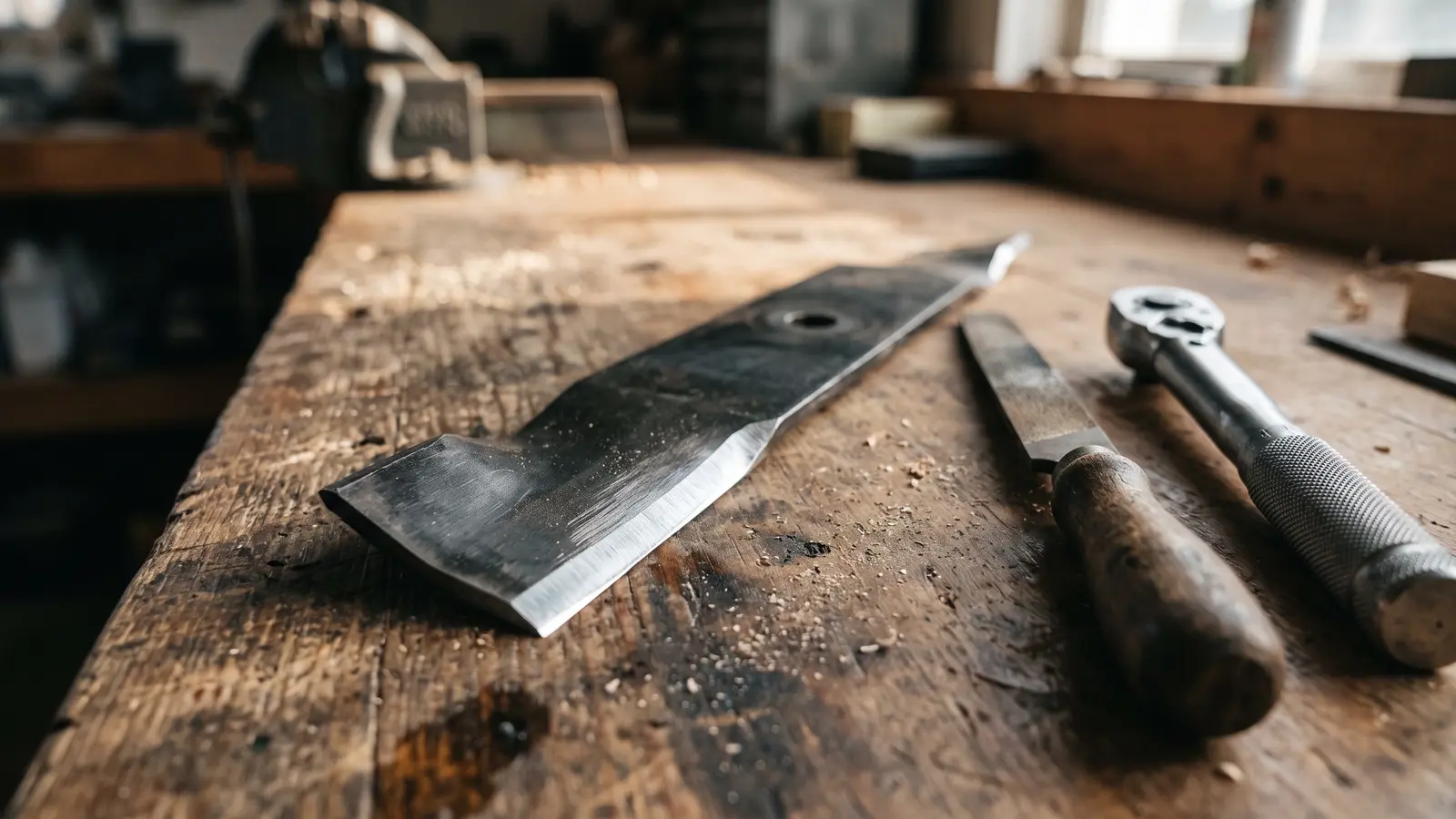
Mower Blade Sharpening: Cadence, Cost, and When to Replace Instead
Blade maintenance is the highest-leverage, lowest-cost habit in cordless mower ownership. A sharp blade cuts cleaner (the lawn heals faster and stays greener), costs less battery (a dull edge makes the motor pull more current — the runtime-drop guide treats it as a top suspect), and prevents the streaking that sends people mower-shopping for the wrong reason. The whole discipline fits in one question — sharpen, replace, or leave it alone? — and one honest cadence.
Why cadence beats crisis
A blade dulls gradually, and the lawn compensates for a while — which is why most people sharpen years apart instead of seasons apart. The cost of waiting compounds quietly:
- Cut quality: torn grass tips brown off a day after mowing; the lawn looks drought-stressed when it’s really blade-stressed
- Runtime: tearing takes more current than cutting; the runtime guide shows up in shortened mows long before owners connect it to the blade
- Streaks: the uncut-grass guide’s most common cause is an edge that’s past its prime
- Motor and pack wear: sustained overcurrent is the least visible tax of all
The common rule of thumb from mower manuals and service shops lands around every 20–25 hours of mowing for a sharpening check — for a typical suburban lawn, once or twice a season, with conditions (sandy soil, lots of edges and roots) shortening that.
The inspection: five minutes, two verdicts
With the battery pack removed and the mower tipped per the manual (spark-plug-side considerations don’t apply — but fuel and oil ones don’t either; cordless makes this the easiest blade access in mowing):
- Look at the cutting edge. A healthy edge is a clean bevel. Nicks, a rolled (rounded) edge, or visible thinning at the tips = sharpen now.
- Check each wing. A bent wing is an automatic replacement — the blade’s lift geometry can’t be restored, and straightened steel at blade speed is a hazard, not a repair.
- Check for cracks anywhere in the steel, especially at the center hole and along the blade body. Any crack is an immediate replacement; no exceptions.
- Note the blade’s overall thickness. Blades that have been sharpened many times get thin at the ends — thin tips flex, cut unevenly, and can fatigue. A blade that’s noticeably tapered toward the tips is done.
- While you’re under there: scrape the deck. Caked clippings change airflow exactly like a bad blade does.
Sharpening: three ways, all legitimate
| Method | Cost | Time | Best for |
|---|---|---|---|
| File by hand | A few dollars for a good mill file | 20–30 minutes | The standard DIY method; most control |
| Bench grinder / drill attachment | Tool-dependent | 10–15 minutes | Heavily nicked blades; requires a light touch |
| Small-engine or mower shop | Commonly a modest shop-rate fee | Same-day, often while-you-wait | No tools, no tip-toes; includes balancing |
The mechanics are the same everywhere: restore the bevel the manufacturer ground — don’t invent a new angle — keep pressure light, cool the steel (dip or pause; blue steel has lost its temper), and take equal passes off both ends. Equal metal off both sides is not a style point; it’s the balance requirement below.
Balancing is not optional
A blade with more weight on one end vibrates at speed — hard on the motor bearings, the spindle, and your hands, and over enough hours, on the mower’s structure. A cone-style balancer (a few dollars) or even a nail through the center hole in a pinch tells you in seconds: the heavy side drops, you file it a touch more, and you repeat until the blade sits level. Shops do this as part of the service; DIY sharpeners should own the balancer.
Reinstallation: the details that matter
- Orientation: cutting edges toward the grass, wings up into the deck. An upside-down blade streaks instantly — the uncut-grass guide’s most instructive failure.
- Torque: blades have a torque specification in the manual, and it exists because under-torqued blades loosen and over-torqued ones stretch the fastener. A torque wrench is the correct tool; “very tight” is not a specification.
- Re-check torque after the first mow following any blade work. It’s a one-minute habit that catches the settling almost every manual warns about.
Replace instead of sharpen when…
| Condition | Verdict | Why |
|---|---|---|
| Bent wing or bent blade | Replace | Geometry can’t be restored; straightened steel is unsafe at speed |
| Any crack | Replace immediately | Cracks propagate; a thrown blade section is catastrophic |
| Sharpened thin / tapered tips | Replace | Thin steel flexes, cuts unevenly, fatigues |
| Out of balance even after equal filing | Replace | The blade has left its design envelope |
| Mulching blade with worn serrations | Replace | Mulching function lives in the geometry, not the edge |
Replacement blades are inexpensive relative to everything they touch — the deck, the motor, the pack, the lawn. A season-start habit of look-then-decide keeps the choice obvious. For mulching decks specifically, the mulching guide covers why serration geometry matters more than edge sharpness.
Cordless-specific notes
Two things make blade care more important on battery mowers, not less:
- The battery pays for a dull blade in runtime — there’s no gas tank absorbing the extra load. The runtime-drop guide’s ladder starts with the pack but lands here.
- Blade access is easier — no fuel to tip, no oil to flood. The five-minute inspection this article recommends is genuinely five minutes on a cordless deck, which removes the last excuse.
And the honest upgrade note: if sharpening cadence is being kept, the blade is fine, and the lawn still loses the growth war every May, that’s a mower-capacity question, not a blade question — the thick-grass guide and the robot-versus-walk-behind comparison cover that decision honestly.
FAQ
How often should a lawn mower blade be sharpened?
A common rule of thumb from manuals and service shops: check the edge every 20–25 mowing hours, which lands most owners at once or twice a season. Sandy soil, lots of concrete edges, and buried roots shorten the interval. The lawn tells you first — streaks and brown tips mean the edge is due regardless of the calendar.
Can I sharpen a mower blade myself?
Yes — a mill file, a clamp, and twenty minutes handles a normal edge refresh, and cordless decks make access trivially safe (remove the pack first). Keep the factory bevel angle, take equal metal from both ends, and balance before reinstalling. Heavily nicked blades go faster on a grinder; anyone who’d rather not own the job can hand it to a shop for a modest fee.
How do I know when to replace rather than sharpen?
Bent, cracked, or out-of-balance after honest filing: replace. Also replace a blade that’s been sharpened thin — tapered tips and a noticeably narrowed profile mean the steel is spent. Blades are inexpensive; the motor, spindle, and deck they protect are not.
Do I really need to balance a mower blade?
Yes. An unbalanced blade vibrates at operating speed, which eats spindle bearings and motor mounts and turns the handle into a paint shaker. A cone balancer costs a few dollars and settles the question in seconds before every reinstall.
Does a sharp blade really save battery runtime?
It’s the most underrated runtime lever: tearing grass takes more current than cleanly shearing it, so a dull edge quietly shortens mows. Owners who sharpen on cadence routinely describe it as getting most of a battery back — it’s the first cheap check in the runtime-drop guide’s ladder.
Why does my new blade leave uncut streaks?
Almost always orientation: installed upside down, the wings point down and flatten grass instead of lifting it into the cut. Reinstall with cutting edges toward the ground, torque to the manual’s spec, and the streaks vanish — the uncut-grass guide walks the full diagnosis if they don’t.