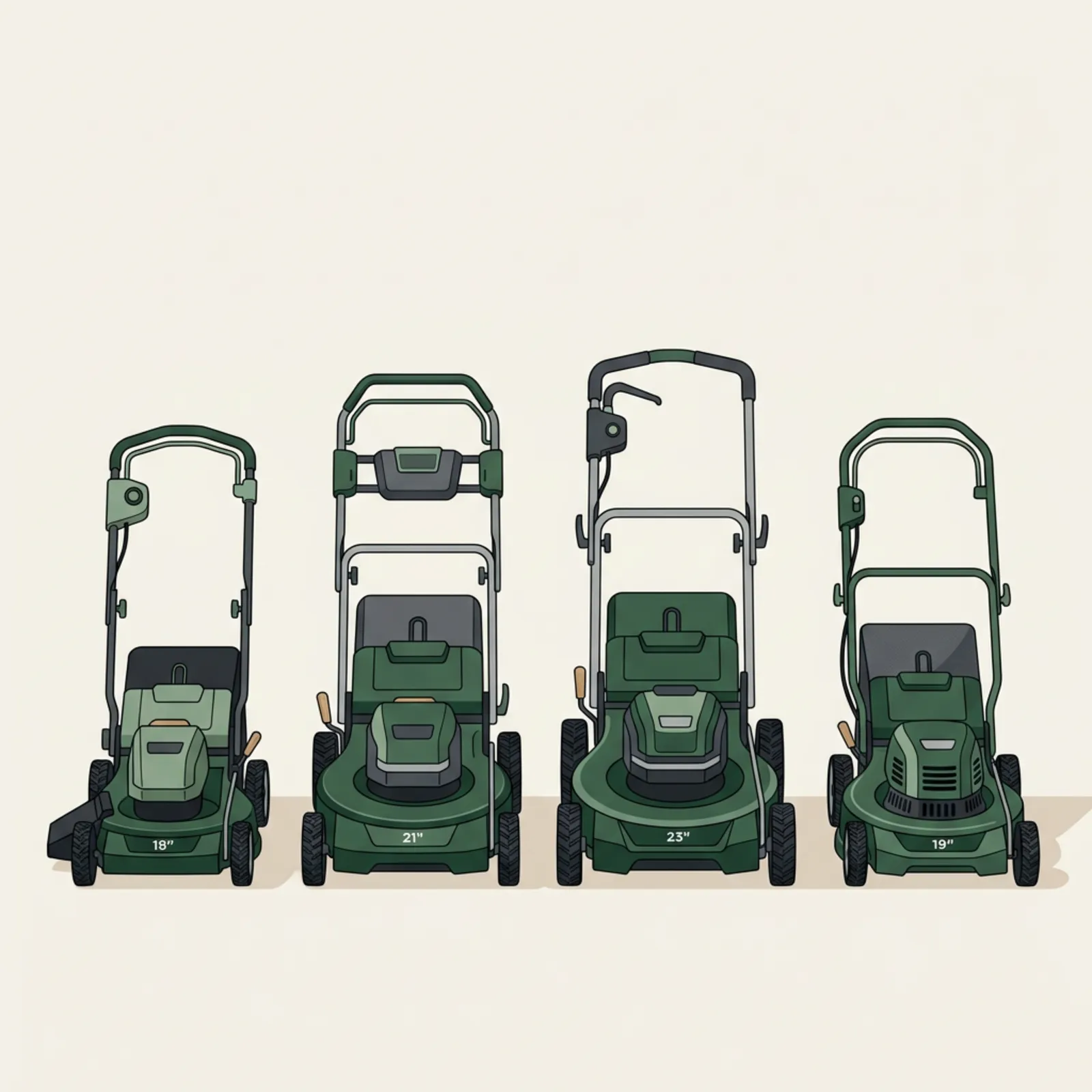
Best Self-Propelled Cordless Mowers (2026)
Self-propelled drive is the single most requested feature in battery mowers, and the least understood. Buyers know it means the mower pushes itself. What the listings don’t say is that the drive motor draws from the same battery as the blade, so every self-propelled cut costs you runtime you’d otherwise spend on grass. This page names the SP models worth shortlisting and puts a number on that trade-off so you can decide whether it’s worth paying.
The self-propelled runtime tax
A self-propelled mower has two motors: one spins the blade, one turns the wheels. Both feed from the same pack. The drive motor isn’t free — on flat ground at walking pace it’s a modest draw, but on thicker grass, uphill stretches, or at the top of the speed dial it climbs fast.
Neither EGO, Greenworks, nor Ryobi publishes a consumption figure per drive mode, so any number here is an estimate. Owner reports across long-term user threads consistently describe noticeably shorter cuts with the drive engaged versus the same mower pushed — a pattern consistent with roughly 20–30% more battery consumption per cut. Treat that as a planning estimate, not a spec: on a mower rated for 60 minutes, expect something closer to 45–50 minutes of self-propelled mowing from the same battery.
The honest framing: SP doesn’t change how much grass you can cut in a session if you own a spare battery — it changes how much grass you can cut per charge. If your yard fits inside one battery with margin, the tax is invisible. If you’re already cutting it close, SP is what pushes you into a second pack.
Who actually needs self-propelled
SP earns its keep in three situations: yards of a quarter acre or more (where the pushing itself becomes the tiring part), any yard with gentle slopes (pushing 70–90 lb uphill is a workout; SP turns it into steering), and anyone with joint issues, a smaller frame, or a reason to dread the push. It’s genuinely one of the best quality-of-life upgrades in lawn care.
It’s wasted in the opposite cases: small flat yards where the mower is moving for 15 minutes, and buyers who’d rather spend the difference on a spare battery — which adds cutting time, while SP only adds comfort.
The picks
The LM2135SP is the pick for most buyers because nothing about it is a compromise: the deck is full-size, the drive is variable-speed rather than single-speed, and the 420 Wh pack is the largest fitted to a mainstream SP mower. The trade-offs are weight — it’s a heavy machine — listings disagree on the exact figure (roughly the 80 lb class; treat as heavy) — and a premium position in its lineup. EGO’s newer LM2156SP XP moves to a 10.0Ah pack and a claimed 75 minutes if you want more runtime per charge; it costs meaningfully more and the standard model remains the value sweet spot. Our full EGO LM2135SP review covers the details.
The LM2108S is the answer for buyers whose priority is finishing the yard on one charge. At 640 Wh it carries roughly 50% more energy than the EGO’s pack, which is exactly what you want if the runtime tax worries you — the drive can take its 20–30% and you still have the deepest reserve here. The counterweights: it’s the heaviest mower in this comparison at a listed 89.1 lb, and Greenworks’ 80V tool ecosystem, while solid, doesn’t match EGO’s breadth. The Greenworks 80V 21-inch review breaks down both the SP flagship and the cheaper push configuration.
The Ryobi plays a different game: instead of one big pack, it runs two 40V batteries in parallel, and those packs power one of the largest tool ecosystems sold at Home Depot. For buyers who already own Ryobi 40V tools, the mower effectively inherits batteries they own — which changes the cost math entirely. Runtime per charge trails the 80V Greenworks, and the warranty is 3 years rather than 4 or 5. The kit most often stocked is the dual-battery SP configuration; Ryobi’s SKU lineup shifts seasonally, so confirm the exact model number on the listing before buying. Our Ryobi 40V HP 21-inch review has the current details.
Check availability on AmazonSide by side
| EGO LM2135SP | Greenworks LM2108S | Ryobi 40V HP 21" | |
|---|---|---|---|
| Voltage | 56V | 80V | 40V × 2 |
| Deck | 21 in | 21 in | 21 in |
| Battery | 7.5Ah (420 Wh) | 8.0Ah (640 Wh) | Dual 40V packs |
| Claimed runtime | Up to 60 min | Up to 80 min | Varies by pack pair |
| Drive | Variable-speed SP | SP | SP |
| Weight | ~80 lb class (sources differ) | 89.1 lb (mfr. spec) | Check listing |
| Warranty | 5-yr tool / 3-yr battery | 4-yr | 3-yr |
| Best for | All-round balance | Runtime per charge | Ecosystem value |
Runtime claims are manufacturer figures for ideal conditions — thick, tall, or damp grass cuts them substantially, and the SP tax comes out of all of them. The battery runtime guide shows how to convert claimed minutes into a realistic expectation for your yard.
The verdict
For most buyers the EGO LM2135SP is the right SP mower: balanced specs, the longest warranty, and a battery platform that grows with you. Choose the Greenworks LM2108S if one-charge completion matters more than anything else, and the Ryobi if you’re already inside its 40V ecosystem or want the lowest-cost entry into a full-size SP mower.
Buy this if…
Your yard is ¼ acre or larger, or has gentle slopes that make pushing genuinely tiring — and your battery budget covers the runtime tax
Skip this if…
Your yard is small and flat, or you’re choosing between SP and a second battery — take the battery
Consider instead if…
You want SP comfort without the premium — the Ryobi kit is the value path, especially if you already own 40V Ryobi tools
Self-propelled cordless mower FAQ
How much runtime does self-propelled use compared to push?
No manufacturer publishes per-mode consumption, so this is an estimate: owner reports consistently point to roughly 20–30% shorter cuts with the drive engaged on the same battery. Plan around it rather than trusting claimed minutes.
Can I mow with the self-propelled disengaged to save battery?
Yes. Every SP mower here runs the blade with the drive off — Greenworks’ own guidance confirms the two systems are independent. Disengaging on flat stretches and engaging only on slopes or thick grass is the standard way to stretch a pack.
Is self-propelled worth it on a small yard?
Usually not. Under a quarter acre of flat ground, the mower runs 15–20 minutes; pushing is not the bottleneck, and the drive’s battery draw is a pure loss. SP starts paying for itself when the walk itself becomes the tiring part.
Do self-propelled battery mowers slow down in thick grass?
The blade motor and drive motor both respond to load. On thick or damp grass the blade draws more, leaving less headroom for the drive, and ground speed drops. Variable-speed drives (like the EGO’s) let you dial the pace down rather than losing the drive entirely.
Which battery platform should I buy into for SP mowing?
The one whose other tools you’ll actually use. EGO has the widest 56V lineup and a 5-year tool warranty; Greenworks 80V buys the most runtime per charge; Ryobi 40V is the cheapest path if you already own its packs. The EGO vs Greenworks comparison and EGO vs Ryobi comparison cover the trade-offs in depth.