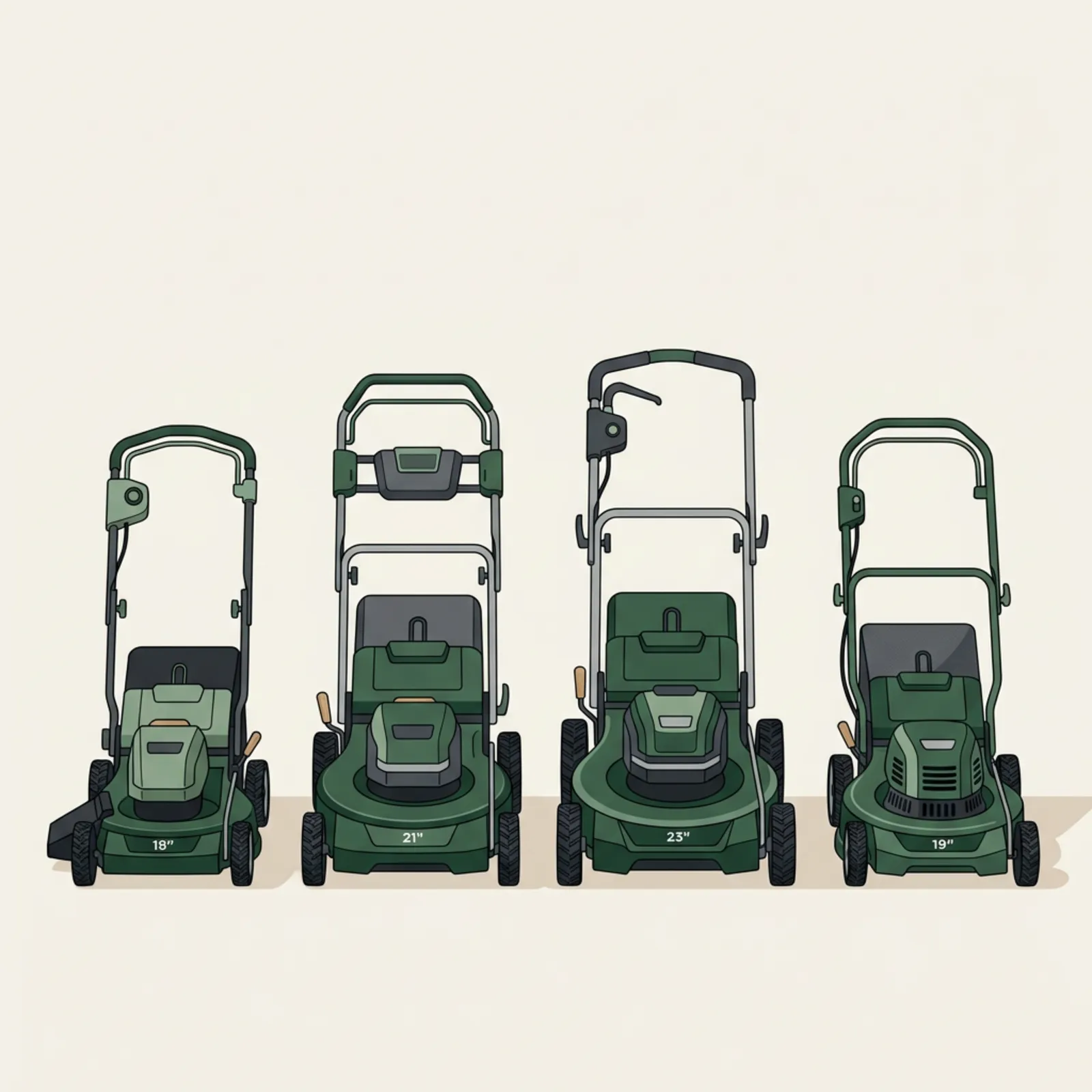
Best Lightweight Cordless Mowers (2026)
Lightweight mowers get marketed with a single number — the pounds — and that number hides the real trade. A 37 lb mower sounds universally better than an 80 lb one until you notice it’s cutting a 13-inch swath instead of a 21-inch one, which means roughly 60% more passes over the same lawn. The useful metric isn’t weight alone; it’s weight per inch of deck, because that’s what tells you whether a mower is genuinely easy to handle or just small.
Pounds per inch of deck
Here’s the framing the listings skip. Every mower’s workload is roughly proportional to the area it cuts, and area per pass is deck width. So the number that predicts how a mower feels is its weight divided by deck width — pounds per inch. Two mowers can weigh the same while one is dramatically easier to use, because it covers more grass per pass and finishes sooner.
The pattern across the current lineup:
- Compact mowers (13–17 in decks, 30–40 lb): around 2–3 lb per deck inch. Effortless to carry and pivot, but each pass covers a narrow strip — a quarter acre becomes a lot of walking.
- Full-size 21-inch mowers (60–90 lb): around 3–4 lb per deck inch. Heavier in absolute terms, yet often lower per inch — meaning more grass cut for every pound you push.
That’s the quiet insight: some full-size mowers are more efficient per pound than the lightweights. A lightweight mower wins when its small deck matches a small yard. It loses when the yard is big enough that the extra passes outweigh the saved pounds.
Who a lightweight mower actually fits
The right buyer for this category has one or more of these constraints: a yard under about a quarter acre (where the narrow deck costs little), stairs or a narrow side gate between the shed and the lawn (where 35 lb vs 80 lb is the difference between a trip and a project), limited storage (compact decks hang or stack in half the space), or a physical reason to avoid heavy equipment. Small flat yards and lightweight mowers are a genuinely good match — this is not a consolation prize category.
The wrong buyer is anyone with a quarter acre or more of grass, or thick-stemmed turf. A 13-inch deck on a half acre is a part-time job, and small motors on tall fescue will bog where a 21-inch brushless deck powers through. If that’s your yard, read the quarter-acre guide instead.
The picks
This is the mower for the smallest lawns and the tightest constraints. The 13-inch deck is genuinely small — expect roughly double the passes of a 21-inch mower on the same grass — but on a lawn that takes 15 minutes anyway, that cost is trivial, and the light weight pays you back every time you lift it over a step or stand it on end in a closet. Greenworks’ current lineup confirms the 13-inch 24V mower remains its compact tier, and the 24V platform’s tool breadth has expanded substantially. The trade-offs are runtime (small pack, small yard — matched) and zero headroom for thick grass. Our small-yards guide covers this class in full.
The WG743 is the pick for buyers who find 13 inches too small but don’t want a 60-plus-pound 21-inch machine. The 17-inch deck splits the difference on passes, the 2×20V battery arrangement shares cells with WORX’s broad Power Share lineup, and the deck folds for compact storage. WORX’s current mower lineup confirms the 17-inch 40V class remains in production. Verify the exact kit configuration and current specs on the listing before purchase — WORX ships this deck in several battery combinations.
The LM2110SP exists for the buyer who wants the lightweight experience without the lightweight deck. It’s a full 21-inch mower, so it cuts like one, but EGO positions it below the flagship LM2135SP with a lighter build and a simpler feature set — and keeps the 5-year tool warranty and the 56V battery platform. Note the weight caveat: EGO’s published figures for this model have shown discrepancies between listing sources, so verify the current listed weight on the product page before buying if a few pounds matter to your situation. The EGO LM2135SP review covers the flagship it sits beneath.
See current options on AmazonSide by side
| Greenworks 24V 13" | WORX WG743 | EGO LM2110SP | |
|---|---|---|---|
| Deck | 13 in | 17 in | 21 in |
| Voltage | 24V | 40V (2×20V) | 56V |
| Drive | Push | Push | Self-propelled |
| Weight class | Lightest (verify listing) | Light-mid (verify listing) | Light for full-size (verify listing) |
| lb per deck inch | ~2–3 (est.) | ~2–3 (est.) | ~3 (est.) |
| Best yard | Under ⅛ acre | Up to ~¼ acre | ¼ acre, flat |
| Warranty | 3–4-yr (varies by SKU) | Check listing | 5-yr tool |
Weight figures for the Greenworks and WORX kits vary by battery configuration and listing source, and EGO’s published weights for this class have shown discrepancies between sources — verify the current listed weight on each product page before buying. The lb-per-inch figures are estimates from typical class weights, not manufacturer specs.
The verdict
Match the deck to the yard, then take the lightest mower that cuts it. Under an eighth of an acre: the Greenworks 24V 13-inch, and enjoy the easiest mower ownership in the category. Up to a quarter acre: the WORX WG743 balances deck and weight best. A quarter acre with a preference for full-size width and drive assist: the EGO LM2110SP. Past that, the extra pounds of a full-size 21-inch mower are buying you fewer passes — a trade worth making.
Buy this if…
Your yard is small and flat, you carry the mower through gates or over steps, or storage space is tight
Skip this if…
Your yard is a quarter acre or larger, or your grass runs thick and tall — a 13–17 inch deck will make you work for it
Consider instead if…
You want light weight but a bigger yard — the EGO LM2110SP gives full-size width at the light end of the 21-inch class
Lightweight mower FAQ
Is a 13-inch deck too small?
For lawns under about an eighth of an acre, no — the extra passes cost minutes, not hours. For a quarter acre or more, yes: you’ll spend roughly twice the walking time of a 21-inch mower for the same cut.
What does pounds-per-inch-of-deck tell me?
It normalizes weight against cutting width, so you can compare a 37 lb compact against an 80 lb full-size mower fairly. A heavier mower with a much wider deck can be easier per square foot cut — the lightweight advantage is real mainly when the deck matches your yard.
Do lightweight mowers have weaker cutting power?
Generally yes — small decks come with smaller motors and lower-voltage packs. On typical suburban grass that’s fine; on thick, tall, or damp growth, compact mowers bog where 21-inch brushless decks keep cutting. Match the mower to your grass, not just your square footage.
Are lightweight mowers cheaper to own?
Usually, yes: smaller batteries cost less to replace, and many kits include the pack and charger. But check runtime against your yard — if a small pack forces a mid-mow recharge on a lawn that’s bigger than it looks, the spare-battery cost erodes the savings.
Which lightweight mower has the best battery platform?
Depends on your other tools. WORX Power Share shares 20V cells across a wide lineup, Greenworks 24V POWERALL is the broadest low-cost platform, and EGO 56V is the premium option with the 5-year warranty. The EGO vs Greenworks comparison covers the platform trade-offs.