Best Cordless Mowers for Hills & Slopes (2026)
Slope changes the mower shopping list more than yard size does. On flat ground, weight is a comfort issue. On a hill, weight is a safety issue: a heavy mower you can’t hold back on a downgrade, or can’t push up a grade without the drive bogging, is the wrong tool no matter how good its specs read. This page ranks the battery mowers that handle slopes honestly — and is equally clear about the grades where no walk-behind belongs.
What actually matters on a slope
Three factors decide slope performance, and marketing pages rarely rank them for you:
Weight, in both directions. Going up, every extra pound is extra load on the motor and on you. Going down, weight is what you’re restraining — a 90 lb mower gathering speed on wet grass is genuinely dangerous. The sweet spot for regular slope work is the lightest machine that still has the power and traction to hold its line.
Traction. Slope capability is mostly a tire-and-drive question. Rear-wheel drive with wider tires holds a line better than front-drive; all-wheel drive holds it best. A powerful mower with narrow hard tires will slip on damp grass long before its motor struggles.
Self-propelled drive. On any grade worth calling a slope, pushing is the problem and SP is the fix. But remember the runtime tax: the drive draws from the same battery, and climbing increases that draw well beyond the flat-ground estimate. Slope work is the single biggest runtime variable in cordless mowing.
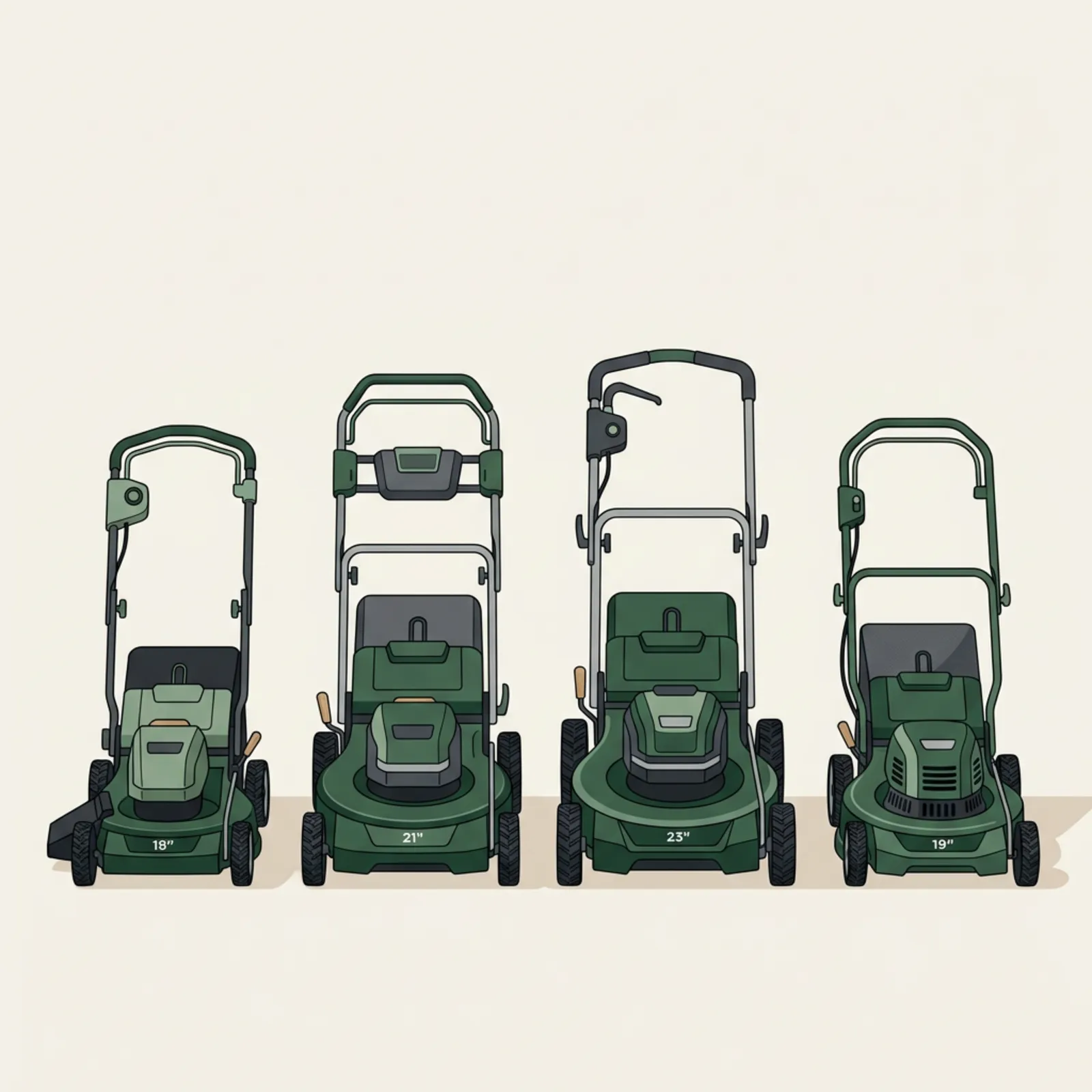
Battery placement is the quiet fourth factor. Packs mounted high on the handle shift weight upward and make a mower feel tippier on side slopes; low, centered deck-mounted packs keep the mass down where it helps. It rarely appears in spec tables, so check product photos before buying.
The slope-safety honesty section
Manufacturers rate walk-behind mowers for slopes up to around 15°, and that rating assumes dry grass, good footwear, and a machine in control the whole time. Beyond that grade, the risk isn’t the mower failing — it’s the operator losing footing or control on a downgrade, which is how most slope injuries actually happen.
Practical thresholds, stated plainly:
- Under 10°: any decent SP mower handles it; weight is your main concern.
- 10–15°: SP with rear-weighted traction is strongly preferred; side-slope passes should run along the contour, not up and down.
- Above 15°: this is where manufacturers stop recommending walk-behind use. Contour mowing with a light push mower is the cautious approach; an AWD robot is the practical one.
- Above ~20°: don’t push a mower on it. This is robot territory or a string trimmer’s job.
If you’re unsure how steep your yard is, hold a carpenter’s level against the slope and read the angle, or use a phone’s built-in inclinometer. Most suburban “hills” are 5–10° and well within any SP mower’s range; the buyers who need this page are the ones with the 15°+ backyard bank.
The picks
On grades under 15°, the LM2135SP is the strongest walk-behind choice because the variable-speed drive lets you match pace to the climb instead of fighting a single fixed speed. The roughly-80-lb mass (listings disagree on the exact figure) cuts both ways: stable and planted on the way up, and something you must control on the way down — walk the downhill passes slowly with the drive at its lowest setting. Full details in the EGO LM2135SP review.
The LMB401 is the counterintuitive pick: on slopes, a lighter push mower can be the safer tool for a fit operator, because the machine you can fully control beats the machine that controls itself. It shares the 80V battery platform with the LM2108S, so stepping up to SP later means buying the drive, not a new battery system. The trade is obvious — you provide the propulsion, and on a 12° climb that’s real work. The Greenworks 80V 21-inch review covers it alongside the SP model.
For yards with sustained grades above 15°, the robot isn’t a luxury — it’s the category that exists precisely because walk-behinds shouldn’t be up there. The LUBA 2 AWD’s 80% slope rating is a manufacturer figure for its drive system, not a guarantee about your specific grass and footing, but the operating principle is sound: the machine holds itself on the slope while you stand on flat ground. It’s a different budget class than the walk-behinds above, and the robot mower hub explains the navigation tech, acreage fit, and setup reality before you commit.
Check availability on AmazonSide by side
| EGO LM2135SP | Greenworks LMB401 | Mammotion LUBA 2 AWD | |
|---|---|---|---|
| Type | Walk-behind SP | Walk-behind push | AWD robot |
| Voltage / power | 56V | 80V | Robot (low-voltage) |
| Deck | 21 in | 21 in | 3 spinning blades |
| Slope capability | Mfr. guidance ~15° max | Mfr. guidance ~15° max | Up to 80% / ~38° (mfr. rating) |
| Weight | ~80 lb class (sources differ) | Lighter than SP flagship | ~46–48 lb (check listing) |
| You stand on the slope | Yes | Yes | No |
| Warranty | 5-yr tool / 3-yr battery | 4-yr | Check listing |
The robot’s weight figure varies by configuration and listing; verify on the product page before buying. Slope ratings for walk-behinds are manufacturer safety guidance, not performance specs — treat 15° as the practical ceiling for regular use.
The verdict
Under 15°, buy the EGO LM2135SP and use the variable-speed drive as your slope control. If you’re fit and your slopes are gentle, the lighter Greenworks LMB401 saves money and mass. Above 15°, or if you simply don’t want to stand on a hillside twice a week, the LUBA 2 AWD is the safer machine — different money, different job, and worth it for the right yard.
See current options on AmazonBuy this if…
Your slopes are under 15° and you want the strongest, most controllable walk-behind — or you’d rather never stand on the slope again and have the budget for a robot
Skip this if…
Your yard is flat — slope capability is a premium you don’t need; start with the overall shortlist instead
Consider instead if…
Your slopes are gentle and your budget is tight — a lightweight push mower plus good footwear covers 5–10° lawns fine
Mowing hills FAQ
How steep is too steep for a walk-behind mower?
Manufacturers rate walk-behinds for slopes up to about 15°, and that assumes dry conditions and good footing. Above 15°, control on the descent becomes the risk; above roughly 20°, don’t push a mower there at all — use an AWD robot or a trimmer.
Should I mow across a slope or up and down?
Across, along the contour, whenever the grade is steep enough to matter. Up-and-down passes put you directly in the mower’s path if it gets away from you downhill, and side-slope mowing along the contour keeps both you and the machine stable.
Do battery mowers lose power on hills?
Climbing increases the load on both the blade and drive motors, and battery voltage sags under heavy load — so yes, expect noticeably shorter runtime on hilly terrain than the manufacturer’s flat-ground claims. Budget a spare battery if your yard is both large and steep.
Is a robot mower safe on steep slopes?
AWD models like the Mammotion LUBA 2 AWD carry manufacturer slope ratings up to 80% (about 38°) and hold themselves on the grade while you stay off the slope entirely. Check the specific model’s rating and your yard’s actual grade before buying — and note that very steep, rough, or wet terrain is still outside any robot’s envelope.
Self-propelled or push for hills?
Self-propelled, for most people. The drive does the climbing work and variable speed lets you control descents precisely. A push mower on hills is the fit-operator’s choice: lighter to restrain, but you supply all the propulsion on every climb.