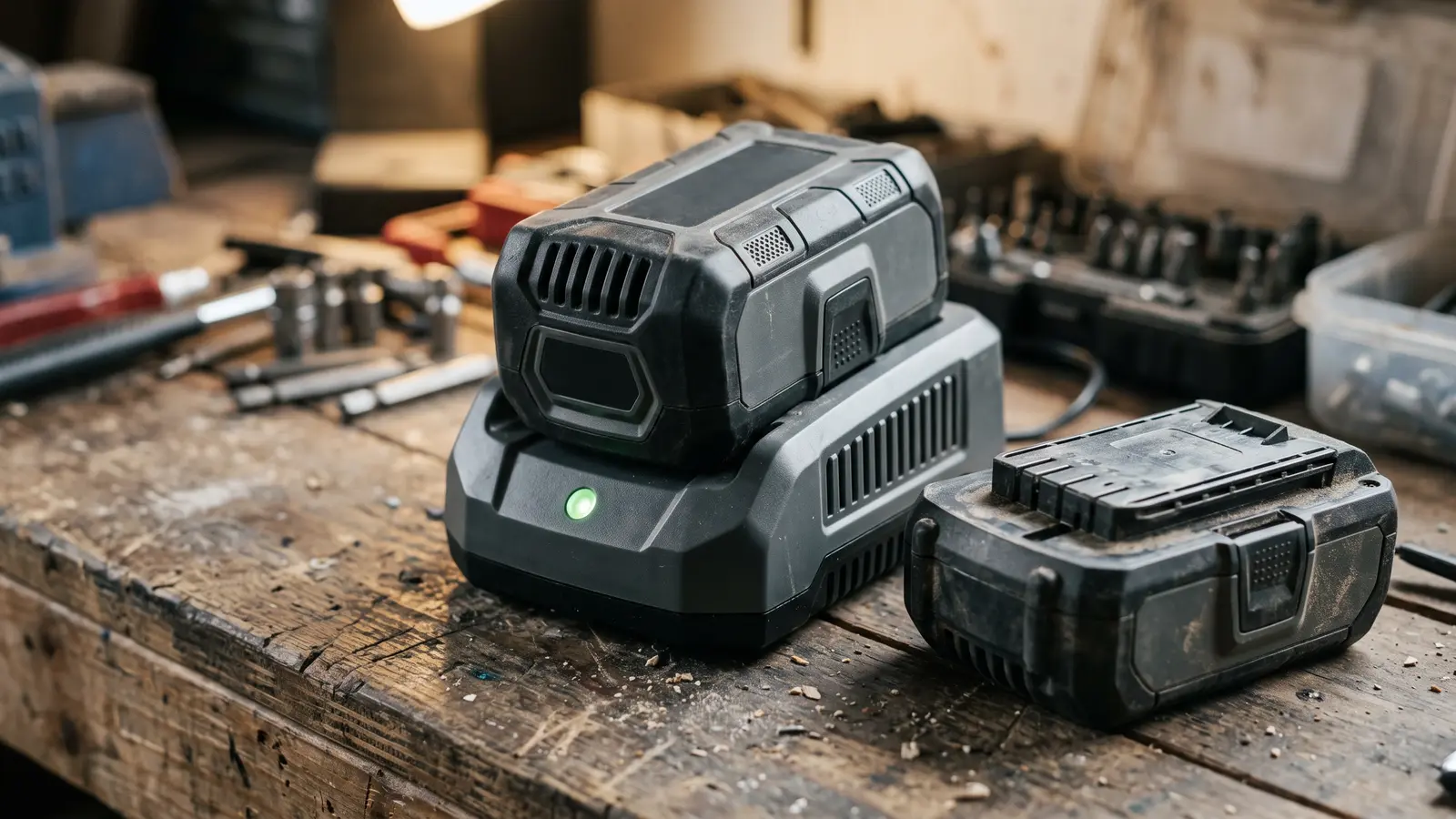
Why Your Cordless Mower Runtime Dropped (and What Actually Helps)
Runtime drop is the slow version of a dead battery: the mower still runs, it just doesn’t finish anymore. A lawn that took one pack now takes one and a bit. The first mow of the day goes fine; the second slows halfway. Because the machine still works, it’s tempting to blame the grass or the weather and keep going — but a real, measured drop almost always has one of six causes, and four of them are fixable without spending anything.
First, measure the drop honestly
Before diagnosing, replace impressions with numbers:
- Charge the suspect pack fully — overnight, indoors, real full, not green-light-and-go.
- Mow a measured section at your normal height and pace until the mower dies or you stop.
- Run the numbers backward with the battery runtime calculator: your lawn’s square footage, your pack’s watt-hours (volts × amp-hours — the watt-hour guide explains the math), and the mow you actually got.
That comparison tells you whether you lost 15% (conditions, probably) or 40% (the pack, almost certainly). A pack near end of life doesn’t fade gracefully to zero — it holds its voltage until the last quarter and then falls off a cliff, which is why last season’s “fine” and this season’s “dies halfway” can sit one winter apart.
Suspect 1: the pack itself (the default answer)
The site’s lifespan coverage sets the baseline: lithium packs are typically rated for 300–500 charge cycles before capacity drops noticeably, and owner reports describe packs fading after 2–3 seasons of weekly mowing while carefully-rotated packs last years longer.
The signature of age is a mow that shortens from the tail: the mower runs at full power, then quits abruptly partway through the job it used to finish. Voltage holds until it doesn’t.
Test: the second-pack swap, same lawn, same week. Second pack finishes = original pack is the answer. Both packs are the same age? The test is still informative — both fading together reads as “the mower’s dying early,” which is why owners with two same-age packs often misdiagnose a battery problem as a motor problem.
Fix: replacement, at the $100+ per-pack price owners report — or better, stagger the ages. Replace one pack now, keep the older as the finisher/backup, and the rotation guidance in the mixing-sizes page applies.
Suspect 2: the blade (the invisible tax)
A dull blade is a runtime thief that hides inside “battery problems.” Blunt edges make the motor work harder for the same cut — more current, more heat, less mow per watt-hour. The sharpening cadence guide covers the timing; the tell that a blade is costing you runtime is browning grass tips a day or two after mowing (torn, not cut) and streaks of uncut grass in the worst patches — the streaks page walks that diagnosis in full.
Test: sharpen (or have a shop sharpen) the blade, then re-run your measured section. A blade that was overdue commonly returns a surprising share of “lost” runtime.
Fix: sharpening at the right cadence — and honesty about replacement when the blade is thin, bent, or has been sharpened past its balance.
Suspect 3: the grass, honestly assessed
The site’s condition-specific guides exist because grass state moves runtime more than most specs on the box:
- Thick, dense spring growth pulls more power than any other condition — the thick-grass guide’s slow-pace, higher-deck pattern is also the runtime-preserving pattern.
- Wet grass adds drag and clumping; the wet-grass guide covers why the same lawn after rain can cost a meaningful slice of a pack.
- An overgrown lawn (the two-week vacation case) is simply more work per square foot. If your “runtime drop” coincides with a stretch of skipped mows, mow it twice at two heights before blaming hardware.
Test: mow the same lawn at the same height one week apart — once in tough conditions, once in normal ones. The gap is your conditions tax, not your battery.
Suspect 4: self-propel and speed settings
Self-propel is a second motor, and on hilly lawns it’s a hungry one. If this season’s drop coincided with using self-propel more (an injury, a new schedule, a slope that got steeper in your mind’s eye), the drive motor is eating the difference. The self-propelled-versus-push guide prices that trade as the “runtime tax” — the same math applies at diagnosis time. Slowing the drive speed to walking pace is the cheapest runtime recovery on this list.
Suspect 5: heat
Lithium packs protect themselves in high heat by throttling output — a pack that finished the lawn at 70°F can shut down early on a 95°F afternoon, especially pushing a hot mower through thick grass. That’s protection, not permanent damage, but it reads as runtime loss. Mowing in the cooler half of the day is the fix that costs nothing.
Suspect 6: the charger (the quiet one)
A charger drifting out of spec can “complete” charges early — the pack shows green at 85% and the mower inherits the shortfall. This is rare, but the no-start ladder’s charger checks (indicator with no pack, a different outlet, contact condition) apply here too. If two packs on one charger both underperform identically, the charger enters the suspect list.
The decision table
| Finding | Verdict | Action |
|---|---|---|
| Second pack finishes the lawn | Original pack aged out | Replace one pack, stagger rotation |
| Both packs quit early, blade overdue | Blade tax on top of aging | Sharpen, re-test, then decide |
| Drop only in thick/wet/overgrown grass | Conditions, not hardware | Adjust pattern per the condition guides |
| Drop only on hot afternoons | Thermal protection | Mow cooler hours; not a fault |
| Drop appeared with heavier self-propel use | Drive-motor tax | Slow the pace or accept the cost |
| Both packs, same charger, identical shortfall | Charger suspect | Borrow or replace charger, re-test |
What not to do
Don’t buy a bigger-voltage mower to solve a blade problem, and don’t buy a mega-amp-hour pack to solve a sharpening deficit — the watt-hours guide explains why a bigger pack on a dull blade just moves the wall farther out. Fix the cheap suspects first; upgrade second, with the runtime calculator deciding whether the upgrade is a pack or a wider deck.
FAQ
How long should a cordless mower battery last per charge?
It scales with watt-hours and conditions, not a single number. Work it out for your own lawn with the runtime calculator: pack watt-hours against your lawn’s square footage. Whatever that budget says for normal conditions is your baseline — a measured shortfall against it is the signal to run this page’s ladder.
Do cordless mower batteries lose capacity over time even if unused?
Yes — calendar aging is real even for packs that sit. That’s why storage habits matter as much as mowing habits: packs kept around half charge in a cool, dry room age far slower than ones pinned full on a charger or drained empty in a shed. The winter storage checklist applies year-round, not just seasonally.
Is it worth buying a second battery or should I replace the old one?
If the old pack still finishes most of the lawn, a second pack of a different age gives you rotation, a diagnostic tool, and a hedge — the mixing-sizes guide covers compatibility. If the old pack quits halfway through a normal lawn, replace it first; a tired pack makes a poor backup.
Can a dull blade really cut my runtime that much?
It’s the most underestimated item on the list. A dull edge converts cutting work into heat and stalling resistance, and the motor compensates with current. Owners who sharpen on cadence routinely report getting “most of a battery back” — it’s the one runtime fix that costs nothing but a file and twenty minutes.
My mower dies only on the back slope. Battery or motor?
Slopes load both walk-behind and self-propel motors. If the same pack finishes flat sections of the same size, the slope is the condition — slow down, raise the deck a notch on the hill, and check the self-propel guide’s hill coverage before replacing parts.