Mower Voltage vs Amp-Hours vs Watt-Hours
If you’ve ever stood in the mower aisle trying to decide between a 40V and an 80V model, you’ve hit the exact confusion this page exists to clear up. The three numbers on a battery label — volts, amp-hours, and watt-hours — answer different questions, and only one of them predicts how long the mower will run. This guide separates them, explains why the 12V battery in a gas rider is a completely different animal from the packs in cordless mowers, and gives you a way to compare packs across brands.
The three numbers, in plain terms
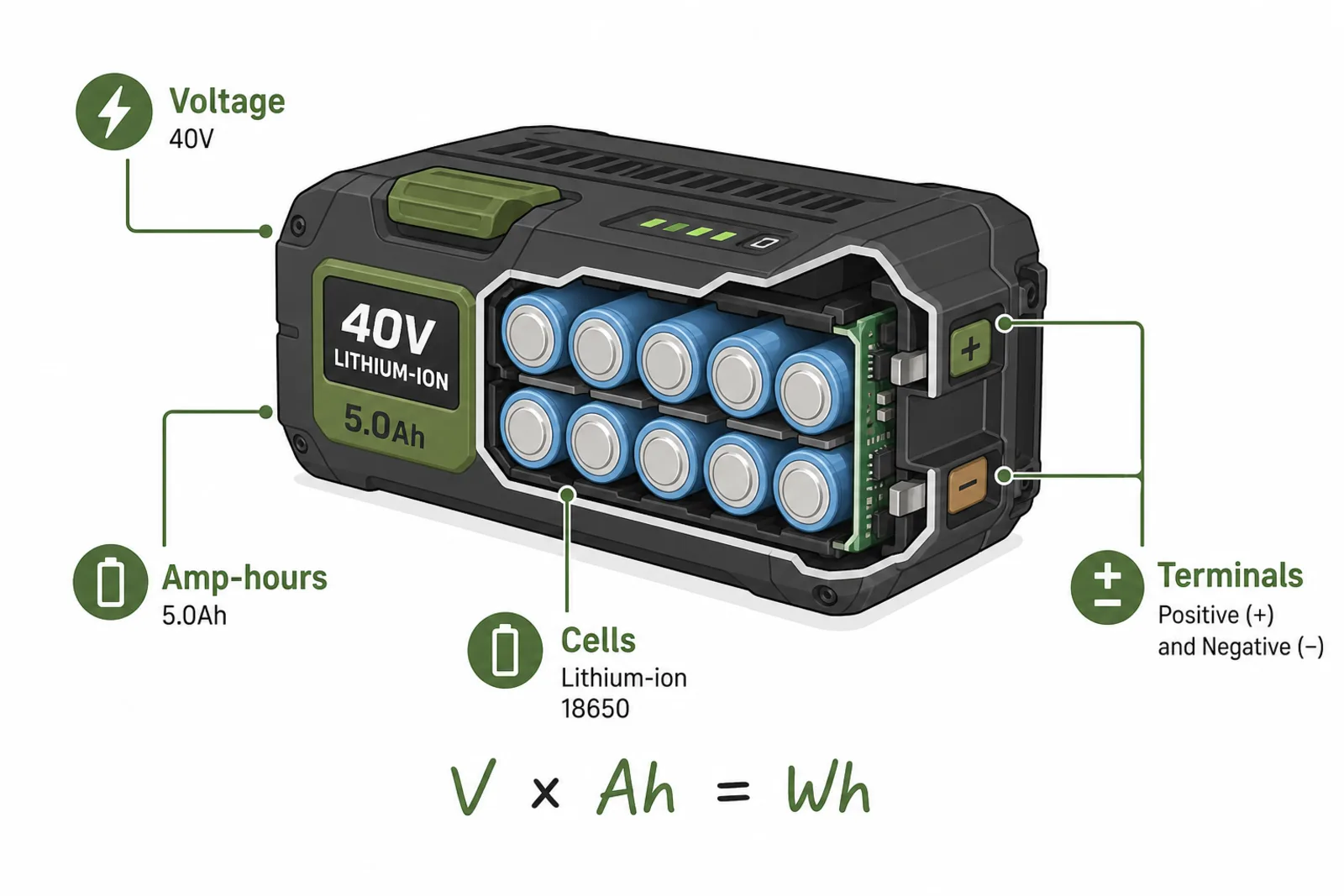
Voltage (V) is the electrical pressure — how hard the mower can push. Higher voltage generally means more torque and more cutting power, which is why 80V mowers tend to feel stronger through thick grass than 40V ones. But voltage alone tells you nothing about runtime.
Amp-hours (Ah) is the capacity of the pack — how much charge it holds. Think of it as the size of the fuel tank. A 7.5Ah pack holds more charge than a 4.0Ah pack, all else equal.
Watt-hours (Wh) is the total energy — voltage × amp-hours. This is the number that actually predicts runtime, because it combines how hard the mower can push (V) with how long it can push (Ah). Two packs with the same watt-hours will run a given mower for about the same time, regardless of their voltage.
56 V × 7.5 Ah = 420 Wh. Watt-hours (volts × amp-hours) are the total energy in the pack — the number that actually predicts runtime. Why voltage alone doesn't tell the story.
That’s the whole trick. The 56V and the 7.5Ah are both real specs, but the number that matters for “will it finish my yard” is the 420 Wh they multiply to.
Why watt-hours is the fair comparison
Here’s where buyers get tripped up. A 40V mower with two 6.0Ah batteries and an 80V mower with one 4.0Ah battery look very different on paper, but the math tells a different story:
80 V × 4.0 Ah = 320 Wh. Watt-hours (volts × amp-hours) are the total energy in the pack — the number that actually predicts runtime. Why voltage alone doesn't tell the story.
That’s 320 Wh in a single 80V pack. Now run the two-battery 40V setup:
40 V × 6.0 Ah = 240 Wh. Watt-hours (volts × amp-hours) are the total energy in the pack — the number that actually predicts runtime. Why voltage alone doesn't tell the story.
That’s 240 Wh per pack, or 480 Wh across two. So the “weaker” 40V mower actually holds more total energy than the 80V one — it just delivers it in two installments. This is exactly the kind of comparison our 40V vs 80V guide works through with real models.
The practical rule: when comparing mowers, convert everything to watt-hours and add up all the batteries that come in the box. That’s your real runtime budget. Voltage tells you about power; watt-hours tells you about endurance.
The 12V trap: starter batteries vs traction packs
Here’s the source of most of the confusion online. Search “lawn mower voltage” and you’ll find page after page about 12V batteries — because that’s what gas riding mowers use for their starter battery. That’s a completely different thing from what’s in a cordless mower, and conflating the two is how people end up confused.
12V starter batteries are small lead-acid (or lithium) batteries that crank a gas engine to start it. They’re not the mower’s power source — the gas engine is. They get recharged by the engine’s charging system while you mow. They’re measured in cold-cranking amps (CCA), not watt-hours, because their job is a short burst of high current, not sustained cutting.
36–80V traction packs are the lithium batteries that actually power cordless mowers. They’re the mower’s only energy source, they’re measured in volts and amp-hours (and therefore watt-hours), and they’re what determines how long you can cut. This is the number that matters for anyone shopping for a cordless mower.
If you’re shopping for a cordless mower, ignore the 12V starter-battery content entirely. It’s answering a different question for a different machine.
How to compare packs across brands
Because watt-hours is just volts × amp-hours, you can compare any two packs directly. Here’s the method:
- Find the voltage and amp-hours on each battery label.
- Multiply them together to get watt-hours.
- Add up all the batteries that come with the mower.
- Compare total watt-hours — that’s your runtime budget.
A few real-world examples to make it concrete:
| Platform | Battery | Watt-hours |
|---|---|---|
| EGO 56V | 7.5Ah | 420 Wh |
| Greenworks 80V | 8.0Ah | 640 Wh |
| Ryobi 40V | 2 × 6.0Ah | 480 Wh total |
The Greenworks 80V pack holds the most energy of the three, which is why it’s rated for longer runtime. The Ryobi’s two 40V packs together beat a single EGO 7.5Ah pack on total energy, even though each individual pack is smaller. That’s the watt-hour view in action.
What voltage actually buys you
If watt-hours predicts runtime, why does voltage matter at all? Because power delivery and torque scale with voltage. An 80V mower can generally push through thicker, wetter grass with less bogging than a 40V mower at the same watt-hours. Higher voltage also tends to mean the mower can sustain its cut speed under load.
So the honest summary is: voltage buys power, watt-hours buy runtime, and amp-hours is just the middle number that combines with voltage to give you watt-hours. For a flat, well-kept lawn, a 40V mower with enough watt-hours will do the job fine. For thick grass, hills, or a bigger yard, the extra torque of a higher-voltage platform is worth considering — and the 40V vs 80V comparison works through exactly when that’s worth it.
Is a higher voltage mower always better?
No. Higher voltage generally means more cutting power and torque, but runtime comes from watt-hours (volts × amp-hours). An 80V mower with a small battery can run out of energy faster than a 40V mower with a large battery. Compare watt-hours for runtime, and voltage for power.
What's the difference between 12V and 40V mower batteries?
A 12V battery in a gas riding mower is a starter battery that cranks the engine — it’s not the mower’s power source. The 36–80V packs in cordless mowers are traction batteries that power the mower entirely. They’re different machines, different battery chemistry, and different specs.
How do I calculate watt-hours from a battery label?
Multiply the voltage by the amp-hours. A 56V 7.5Ah battery is 56 × 7.5 = 420 watt-hours. If a mower comes with two batteries, add them together for the total.
Does a bigger amp-hour battery last longer?
Yes, all else equal. Amp-hours is the capacity of the pack, so a 7.5Ah battery holds more charge than a 4.0Ah battery at the same voltage. But to compare across different voltages, convert to watt-hours first.
Why do some mowers use two batteries?
Two smaller batteries let a manufacturer hit a higher total watt-hour capacity without a single huge, heavy pack. A 40V mower with two 6.0Ah batteries holds 480 Wh total, which can beat a single larger pack on runtime while keeping each individual battery manageable.
Can I use a higher amp-hour battery in my mower?
Usually yes, if it’s the same voltage and same brand platform — most cordless systems accept larger-capacity packs within the same voltage. Check your mower’s manual for the maximum battery size it supports before buying a bigger pack.