How Long Do Battery Lawn Mowers Actually Last?
How long will a battery mower last? The question sounds simple, but it’s actually three questions, because three separate clocks start ticking the day you unbox the mower — and they expire at very different times. Answer them separately and the picture is clear. Blur them together and you get the two failure modes we see in owner forums: people replacing a perfectly good mower because its pack died, and people with a dead pack and no warranty claim because they can’t find the receipt. Answer them separately and the picture is clear. Blur them together and you get the two failure modes we see in owner forums: people replacing a perfectly good mower because its pack died, and people with a dead pack and no warranty claim because they can’t find the receipt.
For the owner side of this article, we read 28 owner threads across r/lawncare and r/lawnmowers — long-term updates, regret posts, and battery-degradation stories. This is a summary of what owners report, not a test claim: we didn’t run these mowers, and individual experiences vary. Where owners disagree, we say so.
Clock 1: The battery pack — 300–500 cycles, the first to go
A lithium mower pack is typically rated for roughly 300 to 500 full charge cycles before its capacity drops noticeably — often to around 70–80% of what it held when new. At one cut per week, that’s somewhere in the neighborhood of 6 to 10 seasons on paper. Owner reports suggest the real-world number can land well short of that, especially for packs that get drained to empty on every cut.
This is the most common complaint in the threads we read — it surfaced in 12 of the 28 threads we read. One owner, explaining why they’d given up on battery equipment, reported that “after 2-3 years the batteries were shot. And they cost $100+ each to replace” (the thread). Another described packs that had faded until “the battery won’t last more than 10-15 minutes” (the thread). A third was blunter still: “First time you have to buy new batteries you will realize you got scammed” (the thread).
But the same corpus contains the counter-cases, and they matter. In the same second-chance thread, one owner reported a father-in-law’s Ryobi running on “the same batteries for like 6 years” (the thread), and another reported zero battery failures across years of use. The difference between the two groups, as the owners themselves tell it, is less about brand than about habits and margin — which we’ll get to below.
The takeaway: the pack is a consumable, like tires. Expect to buy at least one replacement over the mower’s life, and price that replacement before you buy the mower.
Clock 2: The motor and chassis — 8–10 years or more
The durable part of a battery mower is everything except the battery. Brushless motors have no brushes to wear, no carburetor to clean, no gas to go stale, and no oil to change. With basic care — keep it clean, keep it dry, store it out of the weather — the mower itself typically outlasts its first battery by a wide margin. Plan on 8–10 years or more for the machine.
The threads back this up: the complaints are overwhelmingly about packs, chargers, and support — not about motors dying or decks falling apart. When owners describe a mower still going strong, it’s usually the machine that survived while batteries came and went around it.
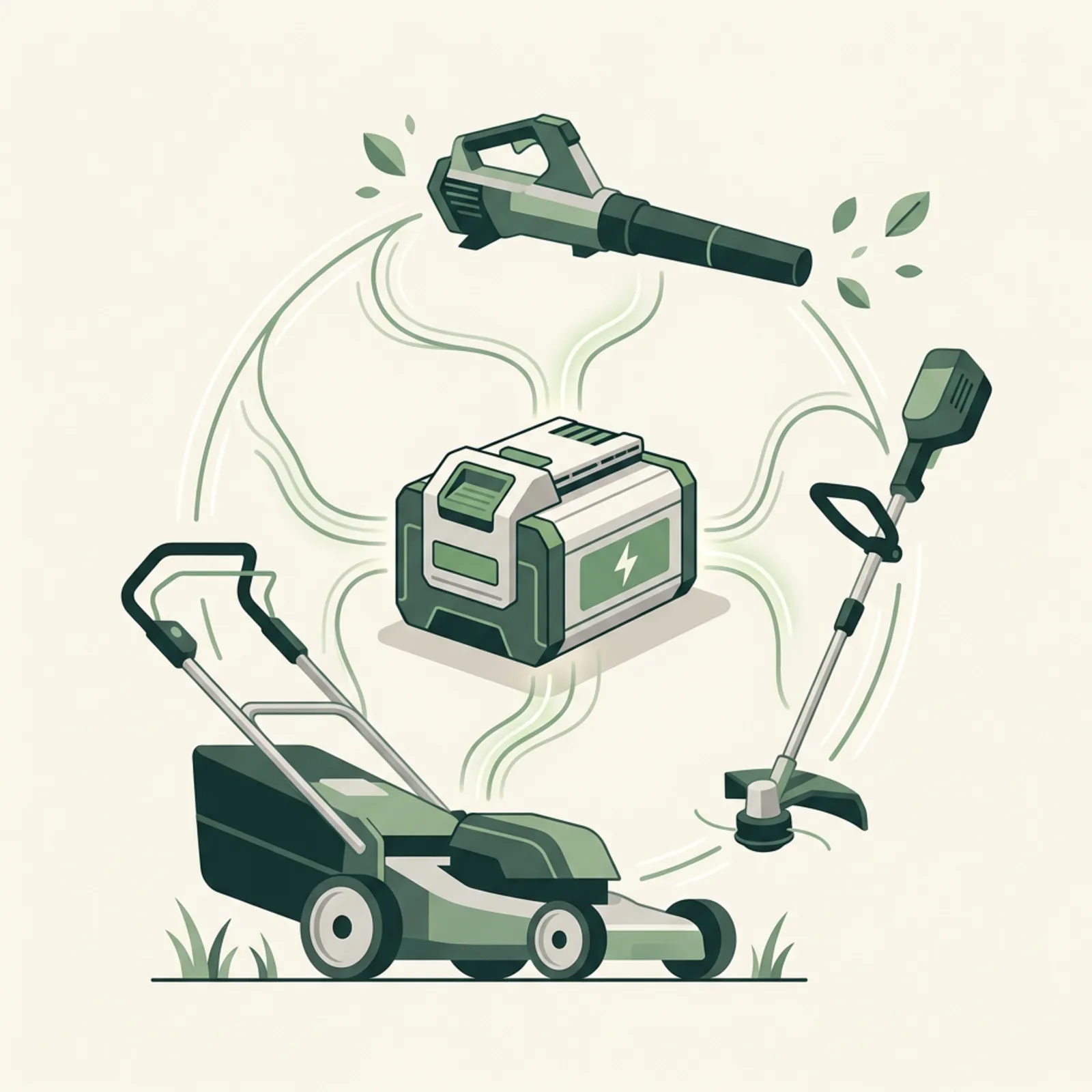
This asymmetry is the single most important thing to internalize before buying: you’re buying a long-lived machine that consumes batteries. The mower is the investment; the pack is the supply. That’s why the platform decision (next section) matters more than any single spec.
Clock 3: The warranty — 3 to 5 years, and only if you can prove it
Warranty terms are the shortest clock, and they differ meaningfully by brand. The pattern across the major platforms: the battery warranty is shorter than (or equal to) the tool warranty, because the battery is the part most likely to fail first.
| Brand | Tool warranty | Battery warranty |
|---|---|---|
| EGO (56V) | 5 years | 3 years |
| Greenworks (80V) | 4 years | 4 years |
| Ryobi (40V) | 3 years | 3 years |
(Manufacturer terms as listed in our reviews and how-we-rate framework; verify current terms before buying, as coverage varies by model and region.)
A warranty only works if you can invoke it, and this is where owner stories turn expensive. In one thread, an owner’s EGO mower died about three years in, and the warranty claim was reportedly denied for lack of a receipt (the thread). Three years of use, a machine that presumably had years of life left in it, and no recourse — because a paper trail didn’t exist.
The takeaway: the warranty is a 3-to-5-year safety net on a part that often fails right around year three. Register the product the week you buy it, and keep the receipt — a photo of the order confirmation is enough.
What owners say wore their packs out — and what they credit for long life
Between the complaint threads and the success stories, a consistent picture emerges of what actually moves battery lifespan.
What owners say kills packs:
- Deep discharges. Running a pack to empty on every cut is the recurring villain. Owners who report long pack life describe rotating two or three packs rather than draining one to zero every time.
- Heat and hard use. Mowing thick grass at full throttle in summer heat is the hardest thing you can ask of a pack — and it’s exactly the scenario in the bogging complaints.
- Storage neglect. One owner who went through a swollen-pack recycling headache noted they had always stored packs indoors and rotated charges over winter — and still saw fast degradation (the thread). Care improves odds; it doesn’t guarantee them.
What owners credit for long life:
- Rotation and margin. The most-cited habit among long-life reports: multiple packs in rotation, none of them ever fully drained. One owner’s advice was to pick an established platform and “stick to it, with proper battery management/rotation” (the thread).
- Buying packs sized with headroom. A cut that ends at 30% remaining is a pack that lives longer. Our runtime guide does this math by yard size, and voltage vs amp-hours explains why two smaller packs often beat one big one for rotation.
How to buy for longevity
Everything above compresses into four buying rules.
1. Buy the platform with the affordable packs. Since the pack is the consumable, the real cost question isn’t the mower’s price — it’s the price of the second and third pack. Before buying any mower, look up what a replacement pack costs on that platform. A mower with cheap, widely available packs is cheaper to own at the same price band. Our EGO, Greenworks 80V, and Ryobi 40V HP reviews all factor replacement-pack economics into the verdicts.
2. Register the warranty and keep the receipt. The no-receipt denial story above is the cautionary tale. Registration takes five minutes at unboxing; the receipt lives in your email either way. This is the cheapest longevity insurance available.
3. Buy from a retailer with easy returns. One owner’s thread was titled “Do not buy from Greenworks site directly” (the thread), citing support and returns friction. One story isn’t a verdict on the brand, but the logic holds generally: a heavy, awkward-to-ship product is exactly the one where easy in-person returns matter if something goes wrong early.
4. Plan the pack rotation from day one. If your yard needs more than about two-thirds of one pack per cut, buy the second pack with the mower — not after the first pack dies. Rotation from the start is the habit owners most consistently credit for long pack life, and it doubles as your runtime margin on thick-grass days.
See current options on AmazonBuy this if…
You want a low-maintenance mower and accept the pack as a planned consumableYou’ll rotate two or more packs and keep them out of deep dischargesYou’ll register the warranty and keep receipts — the owner stories argue strongly for it
Skip this if…
You want a 10-year, zero-replacement purchase — the pack will need replacing before the mower doesYour yard routinely outgrows one pack and you’d rather not buy a secondYou’re set on buying direct from a manufacturer’s web store without checking its return policy first
Consider instead if…
A gas mower, if multi-decade ownership with no battery replacement is the priority — that’s the trade owners in the switch-back threads madeA robot mower, if your yard is small and regularly shaped and you’d rather outsource mowing entirelyOur best cordless mowers roundup for picks that already account for pack economics
FAQ
How long do battery lawn mower batteries actually last?
Lithium packs are typically rated for 300–500 charge cycles before capacity drops noticeably. In the threads we read, owners reported packs fading noticeably after 2–3 years of weekly mowing, while others reported 6+ years of service with rotation and careful charging. Habits and margin matter as much as the rating.
How much does a replacement mower battery cost?
Owners in our corpus reported $100+ per replacement pack. Exact prices vary by voltage and amp-hours, so check the cost of a spare pack for any mower you’re considering — before you buy the mower. The pack is the consumable; its price is the real cost of ownership.
Does the mower itself last as long as a gas mower?
The motor and chassis typically do — 8–10 years or more with basic care, since brushless motors have no carburetor, gas, or oil to maintain. The battery is the limiting part, not the machine. Most owner complaints target packs and support, not motors.
What's the best way to make a mower battery last longer?
The habits owners credit: rotate two or more packs instead of draining one to empty, avoid cutting at the edge of the pack’s capacity, store packs at partial charge out of direct heat, and recharge after use rather than leaving a pack on the mower in a hot shed.
Do I need to keep my receipt for the warranty to work?
In one owner’s account, a warranty claim on a mower that died around year three was denied for lack of proof of purchase (their thread). Register the product when you unbox it and keep the order confirmation — it’s the cheapest insurance in this article.